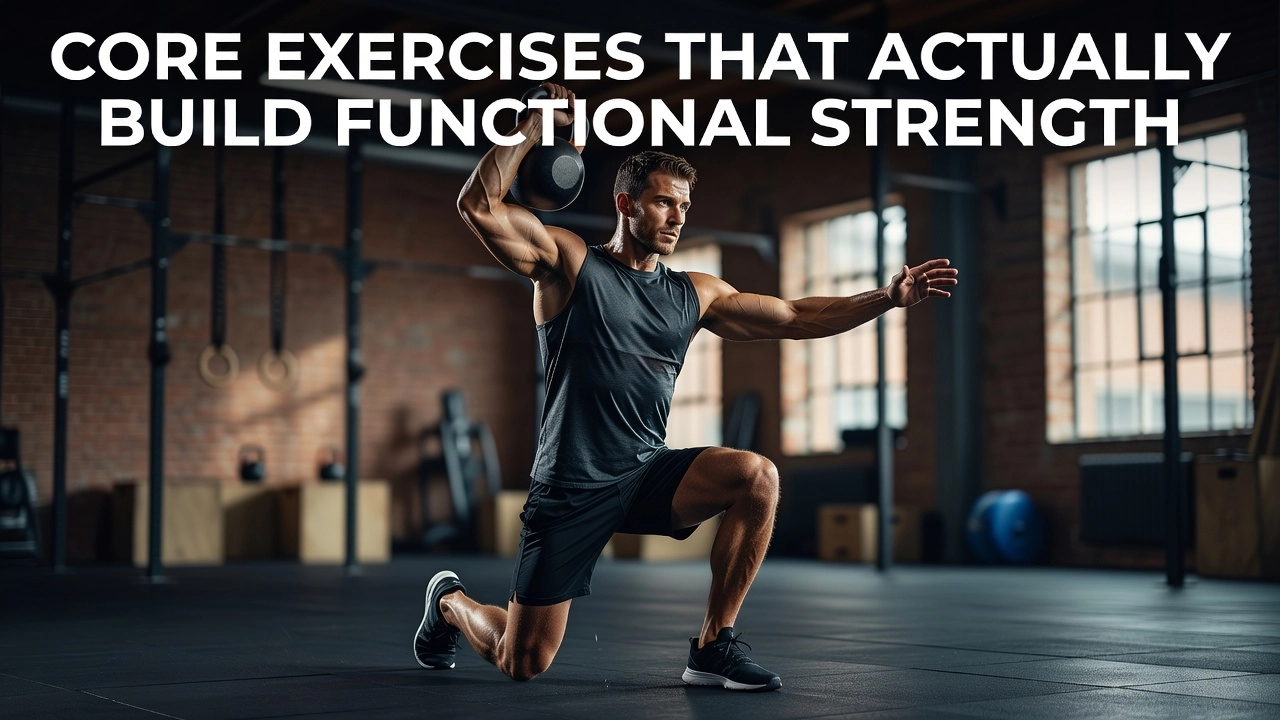
Most people think crunches and sit-ups are the foundation of a strong core. They are wrong. A truly strong core goes far beyond what you can see in the mirror, and the exercises that build it look nothing like what you might expect.
The truth is, your core is a complex system of muscles that supports nearly every movement you make, from picking up groceries to maintaining good posture at your desk. When these muscles are weak, the rest of your body pays the price through back pain, poor balance, and reduced athletic performance.
That is where the right core exercises make all the difference. This list cuts through the noise and focuses on movements that build real, functional strength. Functional strength means your body performs better in everyday life, not just during a workout.
Whether you are brand new to fitness or simply tired of routines that deliver no results, this guide was written with you in mind. By the end, you will have a clear set of proven core exercises that actually work, along with the confidence to get started today.
What Is the Core (And Why It Is More Than Your Abs)
Most people think of the core as the muscles that produce a visible six-pack. That belief leads to training programs built almost entirely around crunches and sit-ups, and it is one of the most common reasons people plateau, develop poor posture, or end up with persistent lower back pain.
The core is a three-dimensional system of muscles that surrounds and stabilizes your entire trunk. It includes the rectus abdominis, obliques, transverse abdominis, erector spinae, and deeper stabilizers such as the multifidus and pelvic floor muscles. Think of it as a canister: the diaphragm forms the roof, the pelvic floor forms the base, and the transverse abdominis and multifidus wrap around the sides and back.
These muscles divide into two functional groups. Superficial muscles, including the rectus abdominis and external obliques, produce visible movement and generate force. Deep stabilizers like the transverse abdominis and multifidus control spinal position, manage intervertebral pressure, and protect your joints during loading. Critically, the deep system activates before movement even begins, preparing the spine in anticipation of force.
Generic training overemphasizes the superficial layer through repetitive flexion movements, leaving the deep stabilizers undertrained and your spine vulnerable. Research consistently links poor deep core coordination to higher injury risk and pelvic floor dysfunction. Understanding this distinction is the foundation of programming that genuinely improves posture, reduces back pain, and transfers to everyday life.
The Real Benefits of Core Training, Backed by Research
Understanding why core training matters starts with a sobering statistic: approximately 80% of U.S. adults will experience low back pain at some point in their lives. That makes core work one of the most clinically relevant forms of exercise available to the general population, not just athletes or rehabilitation patients. When you begin building core strength and stability, you are addressing one of the most common and costly musculoskeletal problems before it has a chance to develop or worsen.
The clinical evidence behind core training is compelling. A 2022 systematic review assigned Grade B evidence to core stability exercises for reducing pain, improving physical function, and increasing core strength in individuals with non-specific low back pain. Grade B reflects consistent findings from moderate-quality studies across both acute and chronic presentations, which is meaningful in the context of a condition that is notoriously difficult to treat. This positions core training not as a trendy fitness concept, but as a clinically supported intervention with real outcomes.
A 2025 meta-analysis reinforced this further. Analyzing 57 randomized controlled trials with over 7,700 participants, researchers found significant pain relief across multiple core training formats, including Pilates, core resistance training, and core stability work. The overall standardized mean difference reached approximately 0.70, a result that reflects genuine, meaningful change in real people across diverse populations.
Beyond pain relief, consistent core training delivers a broader range of functional benefits. Improved posture supports spinal alignment and reduces the compensatory strain that builds up through repetitive daily movement. Better dynamic balance lowers fall and injury risk, which becomes increasingly important as you age. Stronger core muscles also improve force transfer between your upper and lower body, making everything from lifting groceries to climbing stairs feel more controlled and less demanding.
These benefits reflect a wider cultural shift in fitness priorities. The American College of Sports Medicine ranked “Balance, Flow, and Core Strength” as the number five global fitness trend for 2026, placing it above many long-standing training categories. The movement toward stability-driven, functional training over purely aesthetic goals signals that core work is no longer a supplementary addition. It is central to how modern fitness is being defined and delivered.
1. Dead Bug
The dead bug earns its place at the top of this list because it targets the muscles most beginners overlook entirely. Rather than training the superficial abs you can see, it works the transverse abdominis, the deepest layer of your abdominal wall, alongside the internal obliques and pelvic floor. Think of these muscles as the internal scaffolding of your spine. They do not produce visible movement; they produce stability, and that stability is the foundation everything else is built upon.
How to Perform It
Lie flat on your back with both arms extended straight toward the ceiling. Bend your knees to 90 degrees and lift your feet so your shins are parallel to the floor. Press your lower back firmly into the ground. From here, slowly lower your right arm overhead while simultaneously extending your left leg toward the floor, hovering just above it. Return to the start and repeat on the opposite side. Begin with 5 to 8 controlled repetitions per side, prioritising quality over quantity.
The Form Cue That Changes Everything
Your lumbar spine must not lift off the floor at any point during the movement. If a gap appears between your lower back and the mat, your range of motion is too large for your current strength level. Reduce how far you lower the arm and leg until you can maintain contact throughout. This is the single most important checkpoint in the exercise, and it is the one most beginners skip.
How to Progress It
Once you can complete [3 sets of 10 reps per side](https://www.menshealth.com/uk/how-tos/a61885316/dead-bug-exercise/) with a stable spine, introduce a light dumbbell in the extended hand or slow your tempo to a four-second lower and a four-second return. That added time under tension forces your deep stabilisers to work harder without increasing injury risk, making it one of the most effective and safest progressions available to beginners.
2. Bird Dog
The bird dog builds directly on the stability foundation you established with the dead bug. Where the dead bug trains you to resist spinal extension from a supine position, the bird dog demands that same anti-rotation stability from a quadruped stance, adding glute activation and contralateral limb coordination into the equation.
What it trains: This exercise develops your ability to hold a neutral spine under load while opposing limbs move in opposite directions. The transverse abdominis, obliques, and erector spinae all fire simultaneously to prevent the torso from twisting or collapsing. The glutes activate forcefully to drive the leg extension, and the shoulder stabilizers work hard on the supporting side. That combination of demands makes the bird dog exercise one of the most efficient beginner movements available.
How to perform it: Start on hands and knees with wrists beneath shoulders and knees beneath hips. Brace your core gently, then extend one arm forward and the opposite leg back until both are parallel to the floor. Hold for two to three seconds, return with control, and alternate sides. Aim for 8 to 10 controlled reps per side, prioritizing stillness over speed.
Key form cue: The single most common error is allowing the hip on the extending leg side to hike upward. That shift rotates the pelvis, reduces core demand, and transfers stress directly to the lower back. Keep both hip bones level and square throughout the movement.
Progression tip: Extend your hold at full reach to a deliberate three-second pause, or loop a resistance band around your wrists to introduce additional anti-rotation challenge with every repetition.
3. Glute Bridge
The glute bridge rounds out the foundational trio by introducing the posterior chain into your core training. While the dead bug and bird dog train your ability to resist unwanted movement, the glute bridge teaches your glutes, hamstrings, and lumbar stabilizers to work as a coordinated system with the deep core muscles. This integration is what makes it more than a simple glute exercise; it reinforces the same spinal stability you have been building, now through active hip extension.
To perform it correctly, lie on your back with your knees bent and feet flat on the floor, placed hip-width apart. Your heels should sit roughly six to twelve inches from your glutes. Brace your core gently, then drive through your heels to lift your hips until your body forms a straight line from your shoulders to your knees. Squeeze the glutes firmly at the top, hold briefly, and lower with control. Aim for two to three sets of ten to twelve repetitions.
The most important form cue is to avoid hyperextending the lower back at the top. The goal is a straight, neutral line through the hips, not an arched back. Overextending shifts the load away from the glutes and into the lumbar spine, which defeats the purpose entirely. According to research on the supine bridge exercise, maintaining proper alignment is what drives the rehabilitative and strength benefits associated with this movement pattern.
Once the movement feels controlled and repeatable, elevate your feet on a bench to increase the range of motion, or progress to a single-leg variation to challenge unilateral stability. When the pattern is truly solid, placing a barbell across the hips transitions you toward the hip thrust, one of the most effective loaded glute exercises available.
4. Plank Variations
The plank is where core training shifts from movement into position. Unlike the dead bug or bird dog, which train your core through controlled motion, the plank demands that you hold everything together under sustained tension. That distinction matters, because real-world stability often requires exactly this: the ability to brace and maintain position when force is applied.
The forearm plank trains the full anterior core, including the rectus abdominis, transverse abdominis, and obliques, in an isometric anti-extension position. It also develops shoulder girdle stability and teaches coordinated bracing across the entire trunk, including the glutes and legs. Nothing works in isolation here. Every muscle contributes to holding the line.
To perform the forearm plank: place your forearms flat on the floor with elbows stacked directly under your shoulders. Extend your legs back until your body forms a straight line from head to heels. Now actively push the floor away with your forearms, squeeze your glutes hard, and brace your abs as if preparing to absorb a punch. That is full tension, and that is the point.
The most common error is letting the hips sag or pike upward. Both signal that your core has stopped controlling the position. When form breaks, shorten the hold rather than grinding through it.
Progressions to add over time:
- RKC plank: maximum full-body tension held for 10-second intervals
- Plank with shoulder taps: introduces an anti-rotation demand
- Side plank: shifts emphasis to the obliques and lateral hip
Quality holds of 20 to 40 seconds with genuine tension will always outperform passive two-minute holds with sagging hips.
5. Pallof Press
The first four exercises on this list all train your core through movement or static holds. The Pallof press does something fundamentally different. It trains your core to resist rotation, which is arguably the most undertrained quality in standard ab routines and the one that transfers most directly to how your body handles force in real life.
To perform it, anchor a resistance band or cable at chest height. Stand perpendicular to the anchor point with your feet hip-width apart and a slight bend in your knees. Grip the handle or band with both hands at your chest, step out to create tension, then press your arms straight forward until fully extended. Hold that position for one to two seconds, then return slowly to your chest. The entire set is a constant battle against the band trying to rotate your torso toward the anchor. Your job is to not let it.
The non-negotiable form cue here is this: your hips and shoulders must stay square to the front wall throughout every single rep. The moment you feel rotation creeping in, the load is too heavy or your stance needs adjusting. Reduce resistance before you compromise position.
Most generic core content skips this exercise entirely because it focuses on flexion-based movements that look impressive but leave a significant gap. Anti-rotation strength is what helps you carry uneven loads of shopping, absorb contact in sport, or swing a racket without placing stress through your lower back.
To progress, increase the band resistance, slow your tempo on the return phase, or drop into a half-kneeling position to reduce your base of support and demand more from your core stabilisers.
6. Hollow Body Hold
The hollow body hold is a gymnastics-originated exercise that brings everything together into one demanding, full-body position. Where the previous exercises on this list train specific movement patterns or planes of resistance, the hollow body hold requires your entire anterior core to work simultaneously to maintain a single, sustained position against gravity. The primary demand falls on the rectus abdominis, transverse abdominis, and obliques, all of which must work together to create a posterior pelvic tilt and keep your lower back pressed firmly into the floor.
How to perform it: Lie on your back with your legs extended and arms reaching overhead, biceps close to your ears. Press your lower back into the floor by engaging your core and flattening your lumbar curve. From there, lift your shoulder blades slightly and raise your legs to a low angle, maintaining that lower back contact throughout. Your body forms a subtle curve, with tension running from fingertips to toes. Hold this position with controlled breathing for 20 to 40 seconds to start.
The critical form cue every beginner needs: if your lower back lifts off the floor, your legs are too low. Raise them closer to 90 degrees to shorten the lever arm and reduce the demand. Only lower your legs progressively once you can hold a clean, flat-back position for the full duration. Position quality always takes priority over leg height.
Unlike crunches or sit-ups, this exercise builds genuine core tension without momentum, spinal flexion, or hip flexor compensation. Every second of the hold is honest, sustained muscular work. Once you can hold a clean position comfortably, progress by adding small alternating arm and leg flutter movements, known as hollow body rocks, or work toward L-sit progressions for a significantly greater challenge.
7. Loaded Carry (Farmer’s Carry)
Every exercise on this list so far has trained your core in a relatively controlled environment. The loaded carry takes everything you have built and forces it to perform under real-world conditions, while you are moving, breathing, and fighting fatigue.
What it trains is deceptively comprehensive. Picking up a dumbbell or kettlebell and walking with it engages your obliques, transverse abdominis, and erector spinae simultaneously, not in sequence. The most important demand is anti-lateral flexion, which is your core’s ability to resist side-bending when load pulls you off centre. Add to that grip strength, shoulder stability, postural endurance, and full lower-body engagement, and you have one of the most efficient exercises available.
To perform it, pick up a moderately heavy dumbbell or kettlebell in one or both hands. Stand tall, pack your shoulders back and down away from your ears, brace your core, and walk a set distance or for a set time. Keep your gait steady and your head neutral. Start with 20 to 30 seconds and build from there.
The critical form cue applies specifically to the single-arm version: do not lean away from the weight. That lean tells you the core is compensating rather than controlling. Keep your torso vertical and your shoulders level throughout.
This exercise transfers directly to carrying luggage, unloading equipment, or any task performed under load and fatigue. To progress, increase the weight, extend the distance, or use an offset carry with one heavier and one lighter load to amplify the anti-lateral flexion challenge further.
Common Core Training Mistakes That Slow Your Progress
Even with the right exercises in your programme, these four mistakes will quietly sabotage your results.
1. Hip flexor dominance. Sit-ups and leg raises become hip flexor exercises the moment your core fails to brace first. The iliopsoas attaches directly to the lumbar spine, and when it overpowers a weak anterior core, it compresses the discs rather than protecting them. Pre-bracing before every repetition, not mid-movement, is what keeps the work where it belongs.
2. Breath holding and poor bracing strategy. Holding your breath creates unpredictable spikes in intra-abdominal pressure and breaks down your stability between reps. The skill you actually need is learning to maintain a firm brace while continuing to breathe normally, expanding the abdomen against the belt on the inhale without losing tension. This takes deliberate practice and, in most cases, direct coaching to groove correctly.
3. Skipping progressions too quickly. Jumping from basic floor work to weighted rollouts or dragon flags before mastering dead bugs and bird dogs is a fast route to frustration and lower back irritation. The foundational movements exist precisely because they build motor control with minimal compensation. Earn each progression.
4. Treating core work as an afterthought. A few tired planks bolted onto the end of a fatigued session produce poor movement quality and limited adaptation. The nervous system learns best when it is fresh. Placing core stability work earlier in your session, even for ten focused minutes, produces meaningfully better long-term results than the same volume performed at the finish.
How to Program Core Training for Consistent Results
Having the right exercises matters, but knowing how to organise them into a coherent programme is what separates inconsistent effort from reliable progress.
1. Frequency. Two to four dedicated core sessions per week is sufficient for most beginners. More is rarely better, particularly when compound lifts like deadlifts, squats, and overhead pressing already demand significant bracing and stabilisation throughout every rep. Those movements train your core indirectly but meaningfully, so your dedicated sessions should complement that stimulus rather than duplicate it.
2. Progression framework. Begin with the stability-focused exercises covered earlier in this guide, specifically the dead bug, bird dog, and hollow body hold. Once you can perform these with consistent form and controlled breathing, advance to anti-movement work such as the Pallof press and loaded carries. Dynamic, multi-planar patterns are reserved for athletic populations with a solid foundation already in place.
3. Volume guidance. Three to four sets per exercise with a controlled tempo will outperform high-rep sets driven by momentum every time. Quality contractions build durable strength; sloppy repetitions simply reinforce poor movement habits.
4. Session placement. Core stability work belongs early in your session, after your warm-up but before heavy compound lifting. This primes your stabilising system without fatiguing it. Alternatively, a standalone core session focused purely on movement quality is equally effective.
5. Tracking progress. Monitor how long you can hold positions with clean form, how much load you can carry without losing posture, and whether daily discomfort or stiffness is reducing. These markers tell a more accurate story than rep counts alone.
Why Recovery Is Part of Core Training, Not Separate From It
Your programme earns you nothing if your body cannot recover from it. Core muscles, including the transverse abdominis, multifidus, obliques, and diaphragm, are skeletal muscles like any other. They undergo microscopic damage during training and rebuild stronger during rest. Neglecting soft tissue work, mobility, and sleep quality does not just slow progress; it stops it entirely. Plateaus in core strength are frequently a recovery problem, not a programming problem.
Sports massage plays a direct role in core function that most beginners never consider. Tension in the thoracolumbar fascia, a dense connective tissue network linking the spine, pelvis, and surrounding musculature, restricts movement quality and forces the body into compensatory patterns. Tight hip flexors compound this by pulling the pelvis out of neutral alignment, making it nearly impossible to engage the deep stabilisers correctly during exercises like dead bugs or bird dogs. Regular soft tissue work releases these restrictions and restores the mechanical environment the core needs to function as intended.
Between sessions, mobility and flow work maintains the joint range required to execute core exercises correctly. Hip 90/90s, thoracic rotations, and cat-cow sequences are not optional extras; they are structured active recovery that prevents stiffness from accumulating and eroding the movement quality you worked to build.
Nutrition completes the picture. Adequate protein intake supports tissue repair, and consistent hydration directly affects contraction quality and how quickly you recover between sessions.
At The McLeod Method, recovery is embedded into the programme from the start. Every session is planned with your recovery status, movement quality from the previous session, and any soft tissue needs in view, because the core can only engage as intended when the whole system supports it.
Start Building a Core That Works for You
Effective core training goes beyond crunches. It includes deep stabilizers, anti-rotation patterns, and loaded real-world movements that build a core capable of protecting your spine and supporting everything you do.
Your starting point is simple: begin with the dead bug and bird dog to establish a genuine foundation of spinal control and deep muscle activation. Once that stability is consistent, layer in the plank, Pallof press, and loaded carry. Each addition builds on the last, creating a programme that grows with you rather than overwhelming you from the start.
If back pain, poor posture, or a previous injury has made core training feel complicated or even risky, these exercises can be modified and progressed safely. The key is having the right guidance from the beginning.
A meticulous, assessment-led approach in a private one-on-one setting removes the guesswork entirely. Every exercise is selected based on your body mechanics, your current recovery status, and your specific goals, so nothing is wasted and nothing puts you at unnecessary risk. That precision is what turns good intentions into lasting results.
Conclusion
A strong core is not built with endless crunches. It is built with intentional, functional movements that train your body the way it actually moves in real life. The key takeaways are simple: your core is more than your abs, the right exercises carry over into everyday life, traditional sit-ups leave results on the table, and consistency with proven movements changes everything.
Now it is time to put this into action. Choose two or three exercises from this guide and add them to your routine this week. Start slow, focus on form, and build from there.
Your back will feel better. Your posture will improve. Your athletic performance will follow. The strongest version of you is not waiting for a perfect plan. It is waiting for you to start.