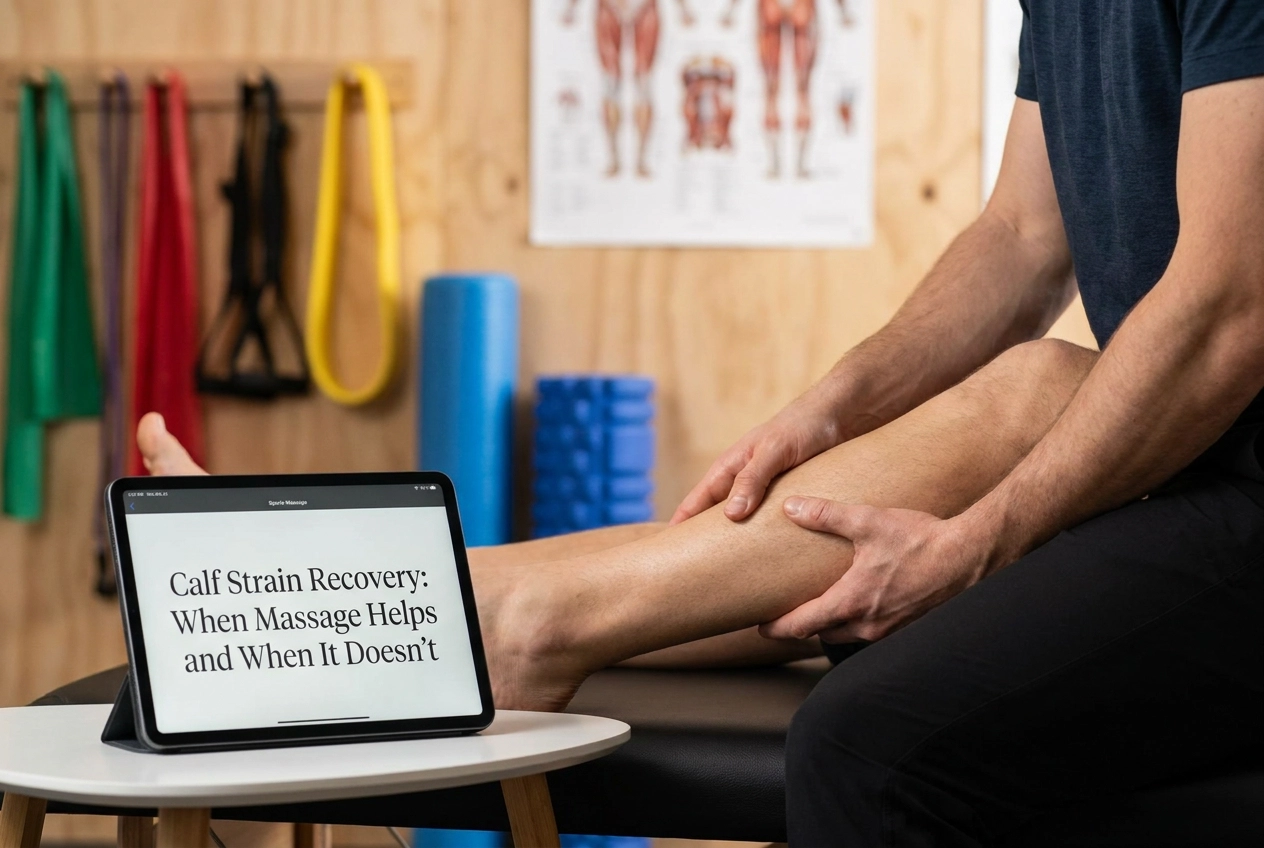
A calf strain can feel like a frustrating stop-start cycle. You rest, it feels better, you push a little, and it tightens up again. The problem for many active people isn’t a lack of effort, but a lack of structure. Recovery from a calf muscle tear follows a predictable timeline, and the most useful question isn’t which therapy is best; it’s which input belongs at each stage.
This guide is designed to walk you through that timeline, stage by stage. We will look at how calf strains are graded and why that grade resets your entire schedule. Then, we will break down the four key phases: from the first 72 hours of protection, through reintroducing movement, back to loading, and finally returning to sport. Along the way, we will be honest about the limits of hands-on work. We will cover exactly where sports massage genuinely helps in tissue tolerance and return-to-load, and where it has almost no role. You will also learn when to see a physio or doctor instead of booking a massage, and get a simple ten-minute weekly check-in to confirm you are really ready for the next stage.
The Stage You Are In Matters More Than the Therapy You Pick
A calf strain is a graded soft tissue injury, not a single condition, so asking “which therapy is best?” misses the useful question: which input belongs at the stage you are in right now. This guide uses four working ranges from practice, not fixed dates: acute (first 72 hours, as a working guide), early subacute (roughly days 3 to 14), return to load (roughly weeks 2 to 6) and return to sport (from about week 4, depending on grade). These are practitioner reasoning rather than research findings, and timelines after muscle strain are still debated.
The position is plain: sports massage has a genuine role in tissue tolerance and return to load, and almost none in the acute stage, where protection and pain control come first. The evidence base on massage for calf strain specifically is limited, so practitioner reasoning will be labelled as such, not presented as a research finding. If you are unsure whether hands-on work belongs yet, use this framework for when you need a sports massage and when to skip it.
Today, write down your injury date, your best guess at grade from the next section, and one thing you are doing about it that you can measure. That is your starting line.
How Calf Strains Are Graded, and Why the Grade Resets Your Whole Timeline
Grading and muscle location reset the timeline your stage guide depends on. No universally accepted grading guidelines exist, so use grade as a communication tool, not a fixed script (Sports Medicine review).
These are approximate clinical descriptors; your treating practitioner will confirm the grade.
Grade I: a few fibres involved. You can walk; calf feels tight and sore rather than sharp; push-off uncomfortable but possible. Return to running takes weeks, not days.
Grade II: larger partial tear. Clear push-off pain, swelling, visible side-to-side strength loss. Graded loading is essential, often supervised; guessing progression causes re-tears.
Grade III: complete or near-complete rupture. Often a pop, immediate push-off loss, bruising tracking down the leg. Medical assessment first, not a hands-on treatment problem.
Which muscle matters as much as grade. Broadly speaking, the gastrocnemius works with a straight knee, the soleus with a bent knee, and the plantaris is small and deep. This changes provoking positions and safe exercises; clinicians use muscle-specific systems and imaging for this reason (Sports MAP).
Action for today: test gently with slow single-leg heel raises on straight and bent knee. Note where and when pain appears; bring that written note to whoever assesses you.
Stage 1, the First 72 Hours: Protect, Settle, Do Not Dig
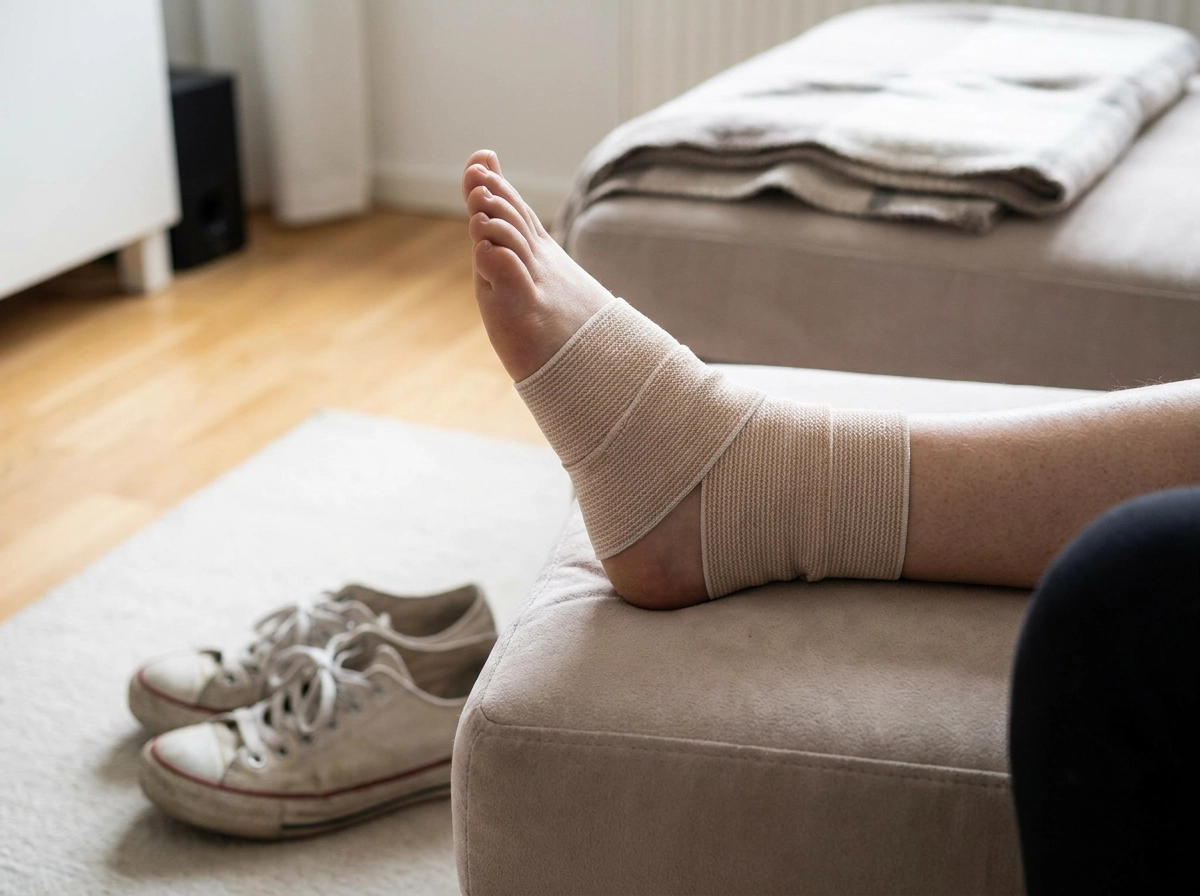
Grade determines protection for the first 72 hours. At every grade, acute-phase torn fibres bleed and surrounding tissue inflames. Expect push-off pain, swelling, morning stiffness; bruising sometimes appears in the day or two after injury.
Relative rest from causative load, not bed rest. Walk and move within comfort, elevate and compress if swelling, and seek proper assessment if unable to bear weight or you felt a pop. The PEACE protocol used in NHS soft tissue guidance prioritises protection and pain control in the first 72 hours.
In practice, hands-on work is not advised in the acute stage, the tissue is still in its initial repair response and does not benefit from additional mechanical input at this point. This is a practical observation, not a measured outcome.
Seek urgent medical review for any of the red flags listed in the “When to See a Physio or Doctor” section.
Remove the aggravating load, walk only as tolerated, and book assessment rather than massage if any red flag applies.
Stage 2, Days 3 to 14: Reintroduce Movement Before You Shop for Hands-On Work
Once the first 72 hours pass without red flags, the job changes. Pain settles, swelling reduces, walking feels normal. Tissue is in early repair and remodelling, so it needs controlled load, not more rest; the opposite of most week-two behaviour.
What belongs: as a working guide, isometric calf loading you tolerate, gentle ankle and calf range work, walking volume, and rebuilding daily capacity such as stairs and uneven ground. A 3-Day Weekly Schedule and Progressions helps space these inputs without overloading the calf. In practice, light sports therapy massage fits as gentle soft tissue work to ease guarding and restore comfortable ankle and calf movement. Treat that as practitioner reasoning about comfort and movement quality, not a proven treatment for the tear, and never as a replacement for loading. Avoid deep transverse work, aggressive stretching into pain, and anyone promising to break down scar tissue or return you faster than tissue allows.
Action for today: choose one isometric calf exercise, work at a tolerable pain level, and record it. If pain climbs over the next 24 hours, the dose was too high, not the exercise wrong. This 24-hour pain-monitoring rule is practitioner reasoning rather than a research finding.
Stage 3, Return to Load: The Stage Where Sports Massage Earns Its Place
Stage 3 covers roughly weeks 2 to 6 for most grade I and II injuries, as a working guide. Build from heavier calf raises to walk-run, steady running, then speed and hills, adding one variable at a time. Here, in practice, hands-on work at this stage is often used to reduce guarding and tightness around a protected leg, keeping ankle and calf range available, and supporting recovery between sessions so you keep hitting loading targets. It supports the programme; it is not the programme. It cannot build tissue strength, replace progressive load, or shorten the timeline alone. Strength comes from load, and making massage the main input is how people stay comfortable and stuck. Book hands-on work one-on-one around your loading, after harder sessions or on a lighter day, not immediately before a key run. That is the approach here: planned and delivered in a private gym setting rather than sold as standalone appointments. Map your next four weeks of loading first, then book a defined block with a review point. That is the approach behind individualised programming, where sessions are planned around your loading, not sold as standalone appointments.
Stage 4, Return to Sport: Test the Calf Instead of Trusting How It Feels
Stage 3 built your loading base. Stage 4 asks whether the calf has regained capacity. Progress on criteria, not the calendar. Criteria will vary by practitioner and sport, but commonly used markers include full pain-free range, calf strength close to the other side, single-leg heel raise capacity without a strength drop, then hopping and change of direction tolerance before full return. These are commonly used markers rather than universal standards. Return-to-sport guidance highlights high recurrence rates, particularly in the period around return, so the last stage deserves the most patience, not the least. Hands-on work supports comfort and mobility here but cannot provide clearance, that comes from your test numbers. If pain returns with every load increase, that is a loading and tolerance problem, not tightness. More massage will not fix it. Step back a level and get the progression reviewed. Today, choose two objective tests, such as single-leg heel raise repetitions and a run at a defined pace, and record both weekly. Use exercise progressions to level up only when those numbers support it.
Where Sports Massage Genuinely Helps in Calf Strain Recovery
Once your test numbers, not feelings, decide your return to sport, hands-on work can still support those weeks. As covered in Stage 3, massage at this phase supports tissue tolerance and maintains range between loading sessions, it is an adjunct to the programme, not the programme itself. A good provider will ask about your grade, stage and current loading before working on the calf, and will be clear about what the session will not do. If they skip those questions, they are selling comfort, not recovery. Action for today: only add hands-on work once you can name the loading it supports. If you cannot, that gap belongs to training. That is the standard behind one-on-one coaching, where programming is planned around your loading, not sold as a standalone appointment.
Where It Doesn’t Help, and What to Do Instead
The limits of hands-on work are just as clear:
- First 72 hours. In practice, hands-on work is not advised here, the tissue is in its initial repair response and additional mechanical input does not help. Protect the area, settle symptoms, and get assessed if you cannot weight bear.
- Suspected grade II or III injuries. If you heard a pop, cannot push off, or have significant bruising and weakness, get an assessment and progression plan first, then decide about hands-on support.
- Unusual pain patterns. Night pain, escalating pain, a hot swollen calf, or pain after immobility needs medical review. Massage is the wrong first move and can delay something that matters.
- Repeated reinjury. Restraining at the same spot signals a load management problem, not a stubborn knot. Review your loading programme and confirm the grade was properly established.
- Chasing tightness. Weekly massage with no loading progression keeps you comfortable and unchanged. Set a measurable goal and end date from the start.
A well-designed remedial session supports a plan; it doesn’t replace one.
When to See a Physio or Doctor Instead of Booking a Massage
If any symptom in the previous section applies, massage is not the next booking. See a doctor today for a pop with immediate loss of function, inability or significant difficulty bearing weight, quickly spreading bruising, a hot swollen tender calf, calf pain with breathlessness or chest pain (this may indicate a circulatory concern unrelated to muscle strain; seek emergency assessment), or calf pain that began or worsened during a period of immobility or long travel (a separate concern from muscle strain, seek medical advice rather than treating it as a strain).
See a physio promptly if the grade is unclear, pain is not settling as your stage suggests, weakness persists after pain resolves, or running keeps stalling at the same point. An assessment adds grading, differential diagnosis, strength and range measurements, and a criteria-based progression. A doctor may add imaging for a suspected complete tear or another cause, and rule out non-muscle reasons hands-on work cannot address.
If you later need to weigh sports therapy massage options, see sports massage vs deep tissue massage.
Today: red flags mean stop and seek medical advice now. Otherwise, book an assessment this week, not another massage.
A Ten Minute Weekly Check-In to Confirm You Are Really in the Next Stage
Once you have ruled out the red flags that need a professional, self-tracking becomes your most reliable tool. Set aside ten minutes on the same day each week to record three metrics: pain during walking and running, your single-leg heel raise repetitions compared with the uninjured side, and how the calf feels the morning after a session.
Pain rule: Keep pain low during activity and settled by the next morning. If pain climbs across consecutive sessions, you have likely overshot your current stage. Drop back rather than push through.
Strength rule: If heel raise repetitions on the injured side remain clearly below the other side, you are still in return to load, not return to sport. The calendar does not overrule the numbers.
Load rule: Change one variable at a time. Progress volume first, then speed, then change of direction, holding each change for a period before adding the next, as a practical guide.
Write these three numbers down now. A trend tells you more about your true stage than how the calf feels on any given morning.
What to Do With All of This
The trend you record matters more than any single morning’s reading, and it should drive two decisions: which stage you are in, and which treatment belongs there. Get the order right. As a working guide, protect and settle for the first 72 hours, reintroduce movement across days 3 to 14, load progressively from around week 2, then test against criteria before sport. These stages reflect practitioner reasoning rather than fixed research timelines.
Use hands-on work where it works: supporting tissue tolerance and return to load, programmed around your training rather than booked as a standalone appointment, with a defined goal and review date so it has an endpoint.
Escalation criteria are set out in the “When to See a Physio or Doctor” section, refer back to those before booking any hands-on work.
Conclusion
Matching your actions to your stage is what drives recovery from a calf strain. Use hands-on work strategically within a loading programme, measure your numbers weekly, and let the trend guide your next decision rather than how the calf feels on any given morning.