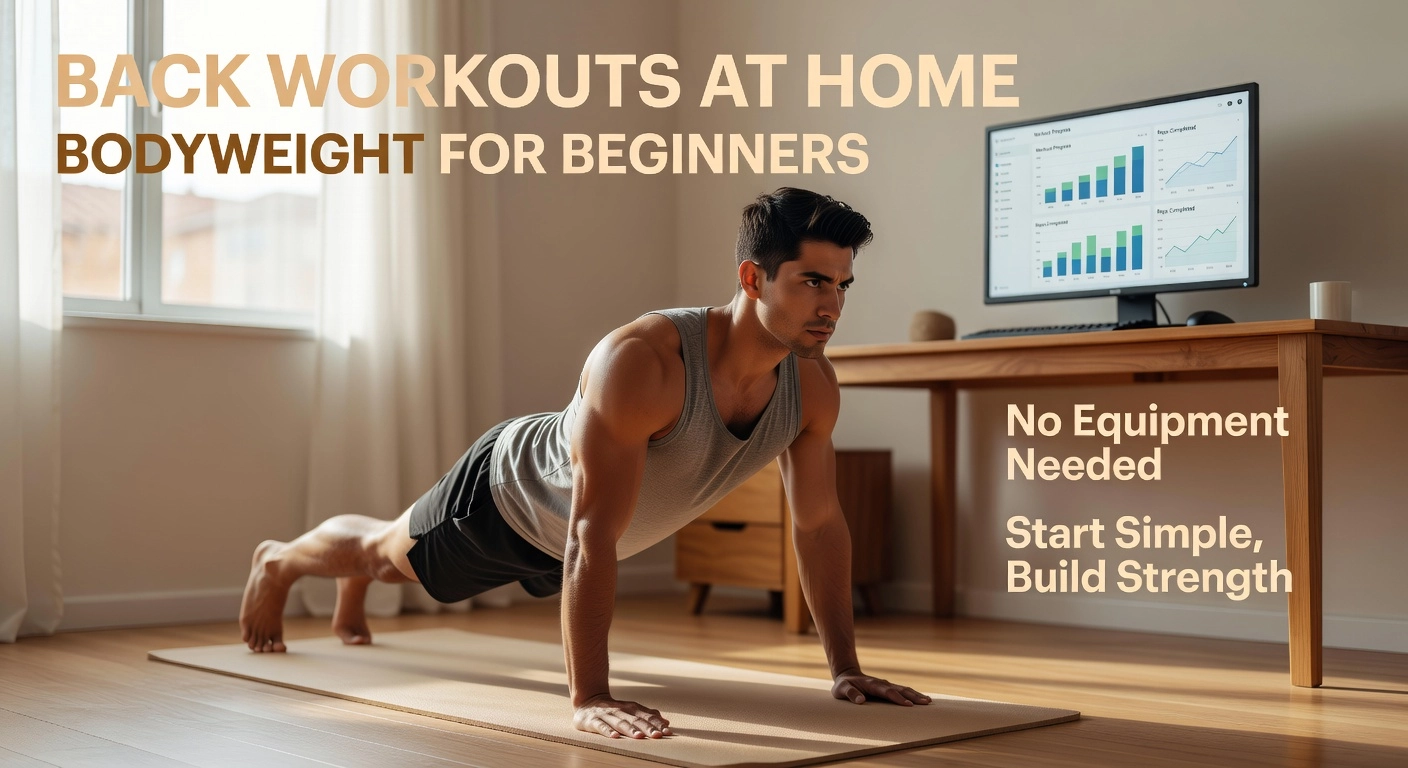
Hey, have you ever caught yourself slouching at your desk after a long day, feeling that nagging tightness in your back? You’re not alone. Most of us spend hours hunched over computers or phones, and it leaves our backs weak and achy. The good news? You don’t need a fancy gym membership or heavy weights to fix it. Back workouts at home using just your bodyweight can build real strength, improve your posture, and boost your confidence, all from your living room.
If you’re a beginner, that’s perfect. This guide is designed for you. We’ll skip the complicated stuff and focus on simple, effective exercises that target your entire back, from your upper traps to your lower lats. You’ll get step-by-step instructions, easy-to-follow form tips to avoid injury, and a beginner-friendly routine you can do in 20 minutes, three times a week. No equipment required, just your motivation and a little space.
By the end, you’ll have the tools to sculpt a stronger, more resilient back right at home. Ready to feel the difference? Let’s get started.
Why Build a Strong Back at Home
Did you know that nearly 80% of adults will experience back pain at some point in their lifetime, according to the Mayo Clinic? It’s a huge issue, especially with our desk-bound lives and constant screen time. The good news? Simple home strengthening exercises using just your bodyweight can slash the recurrence risk by 30-50%. Think about it: moves like bird-dogs or supermans build endurance in your erector spinae and core, supporting your spine without needing fancy gear. This approach keeps you moving pain-free and cuts down on doctor visits.
Fast forward to 2026, and 61% of people are training exclusively at home, per Garage Gym Reviews. This lines up perfectly with the exploding $15 billion home fitness market, fueled by accessible bodyweight routines. No more excuses about gym crowds or memberships; you can transform your living room into a powerhouse for upper, mid, and lower back muscles like the lats, rhomboids, and traps.
The perks go way beyond pain relief. A strong back means better posture to fight that slouch from hunching over laptops, injury prevention by absorbing daily shocks, improved spinal alignment for fluid movement, rock-solid core stability, and even longevity; after all, 70% of folks prioritize strength training now, as noted by Les Mills. For women, it’s a game-changer: desk workers and busy moms get posture fixes to ease neck strain from carrying kids, plus pregnancy-safe options like pelvic tilts that pair beautifully with wellness services such as sports massage. These tie into one-on-one women’s personal training for tailored support.
And here’s the best part for your packed schedule: micro-workouts. Quick 10-20 minute sessions, 3 times a week, fit anywhere. Try a 15-minute circuit with plank variations and YTW raises during lunch; it’s low-impact, scalable for beginners, and sets you up for private gym sessions later. Your back will thank you with lasting strength and confidence.
Key Back Muscles in These Workouts
Let’s dive into the key back muscles you’ll target with these bodyweight workouts at home. First up are the latissimus dorsi, or lats, those wide, wing-like muscles that run from your lower back up to your arms. They power pulling movements, like tugging a door open or rowing an imaginary boat, and play a huge role in keeping your posture tall and strong. Weak lats often lead to slouching, especially if you’re sitting at a desk all day.
Next, the rhomboids and middle/upper trapezius squeeze your shoulder blades together for scapular retraction, aligning your shoulders back and down. This duo fights the forward hunch from phone scrolling and helps with overhead reaches, like grabbing something from a high shelf. For beginners, activating them feels like a gentle back hug that instantly improves your stance.
Finally, the erector spinae are your lower back stabilizers, a group of muscles along the spine that prevent slumping, support twisting, and resist rotation during everyday bends. They act like a natural corset for spinal support.
Targeting these reduces back pain, which hits 80% of adults lifetime per Mayo Clinic stats, cutting recurrence by 30-50% with consistent home strength work. You’ll gain better mobility for twisting and bending, making daily tasks like lifting kids or grocery bags easier and safer. Start with 10-minute sessions 3 times a week to build resilience and feel more confident in your body. Check Men’s Health for form tips.
Prerequisites and Warm-Up Essentials
Before diving into your back workouts at home, let’s set you up for success with the basics. You’ll need just a clear floor space about 6×6 feet, perfect for bodyweight moves like Bird-Dog or Superman holds. A yoga mat is optional but handy for cushioning your knees and spine on hard surfaces, as noted in guides from Copper Fit. Dress in comfy, breathable clothes like fitted leggings and a t-shirt that let you move freely, and keep water nearby, sipping 16-20 ounces before and during to stay hydrated, especially since 70% of people now include strength training in home routines for longevity.
Quick Beginner Safety Check
Always chat with your doctor first if you have back pain, injuries, or conditions like pregnancy; stats show 80% of adults face back issues lifetime, but home strengthening cuts recurrence by 30-50%. Focus on perfect form over reps, starting with 8-12 slow ones. For pregnancy, skip prone positions after the first trimester, swap for standing or quadruped versions like modified Cat-Cow, per OrthoCarolina tips. Nail breathing too: inhale to prep (like lowering down), exhale on effort (lifting or extending) to fire your core and protect your spine.
Your 5-Minute Dynamic Warm-Up
Spend five minutes prepping your posterior chain with these no-gear moves from Everyday Health. Stand and do 10 shoulder rolls forward and back, then arm circles (10 large forward/back). Drop to hands and knees for Cat-Cow: inhale to arch (Cow), exhale to round (10 reps). Finish with marching in place and arm swings for 60 seconds. This boosts blood flow, mobilizes your spine, and activates stabilizers, setting you up injury-free. Ready to build that strong back?
Your 15-Minute Beginner Back Workout Routine
Hey there, let’s jump right into your go-to 15-minute beginner back workout routine designed for back workouts at home with zero equipment. Perfect for busy days, this fits the 2026 micro-workout trend, where short sessions like these boost adherence for over 70% of folks prioritizing strength for longevity, per recent fitness insights. You’ll hit upper, mid, and lower back for better posture and pain relief, building on those key muscles we covered earlier. Expect results like improved stability in just a few weeks with consistency.
Do It 3 Times a Week for Best Results
Aim for three sessions weekly, say Monday, Wednesday, and Friday, with at least one rest day between each for recovery. This frequency allows your latissimus dorsi, rhomboids, trapezius, and erector spinae to repair and grow stronger without overload, especially as a beginner in bodyweight training. Research shows beginners thrive on 2-3 back-focused days to prevent fatigue while seeing posture gains. Skip if sore; pair with light walks on off days. Your body will thank you with less pain risk, as home strengthening cuts recurrence by 30-50%.
Simple Structure: 3 Rounds in 10-20 Minutes
Warm up with the essentials from before, then crush 3 rounds. Do 10-15 reps or 20-30-second holds per exercise, resting 30-45 seconds between moves and 1-2 minutes between rounds. Total time stays under 20 minutes, ideal for ACSM’s top fitness trends for 2026, emphasizing quick “exercise snacks.” Focus on slow, controlled form: squeeze your back muscles at the top. Example: one round takes about 4 minutes.
5 Bodyweight Exercises for Full Back Coverage
- Bird Dog (Mid/Lower Back): On all fours, extend opposite arm and leg, hold 3 seconds, hips level. 10 reps per side. Builds stability.
- Superman (Lower/Upper Back): Face down, lift chest, arms, legs; hold 3-5 seconds. 12 reps. Strengthens erectors.
- Reverse Snow Angel (Upper/Mid Back): Face down, arms at sides, sweep overhead slowly. 10 reps. Fixes slouch.
- IYWT Raises (Upper Back): Face down, cycle I-Y-W-T arm positions, hovering chest. 8 reps. Boosts posture.
- Reverse Plank Hold (Full Back): Hands behind, lift hips straight; squeeze. 25 seconds. Engages everything.
Track Progress and Stay Consistent
Grab a journal or app to log reps, holds, and how you feel, adding 1-2 reps weekly. Consistency beats intensity, per NASM top fitness trends; aim for 80% effort. Notice better mobility? That’s progress toward wellness goals like ours in personal training. Stick with it, and transition seamlessly to more advanced sessions!
1. Superman for Lower Back
Ready to fire up that lower back with one of the simplest yet most effective moves in your back workouts at home arsenal? The Superman exercise is perfect for beginners, zero equipment needed, and it zeroes in on your erector spinae, those key muscles running along your spine that keep you upright and pain-free. Picture this: just like Superman soaring through the sky, you’ll lift off the ground to build strength, improve posture, and even squeeze in some glute work for that posterior chain boost. Studies show moves like this can cut back pain recurrence by 30-50%, vital since 80% of adults face it sometime, per Mayo Clinic insights.
Step-by-Step Instructions
- Lie face down on a mat or soft floor, arms extended forward with palms facing down, legs straight back, and toes lightly touching the ground. Keep your gaze down at the floor, about 6 inches ahead, to protect your neck.
- Engage your core and glutes, then exhale as you lift your chest, arms, and legs simultaneously off the floor by 6 inches. Squeeze those glutes hard at the top for extra stability.
- Hold for 3-5 seconds while breathing steadily, then inhale and lower slowly with control, no dropping.
- Repeat for 10-15 reps, aiming for 2-3 sets with 30-60 seconds rest. Do this 3 times a week in your 15-minute routine.
For beginners, modify by lifting just your arms and chest, or alternate arms and legs like a bird-dog to ease in. A top cue from experts at ACE Fitness: gaze down to dodge neck strain, imagining a tennis ball under your chin. Feel that burn? It’s your erector spinae waking up, supporting everything from daily lifts to wellness goals like better mobility for women’s training sessions. Pair it with a quick sports massage post-workout for recovery, and you’ll notice straighter posture in weeks. As home fitness booms in 2026, with 61% sticking to bodyweight routines, this is your longevity secret. Next up, let’s hit stability!
2. Bird-Dog for Stability
Next up in your back workouts at home, the Bird-Dog is a game-changer for building stability without any gear. This bodyweight move mimics a dog pointing at a bird, extending opposite arm and leg while on all fours, and it’s perfect for beginners since it strengthens your erector spinae, core, and balance all at once. Studies show it activates lumbar stabilizers by 29-40%, helping prevent the back pain that hits 80% of adults lifetime, per Mayo Clinic data. Plus, it’s super safe for pregnancy or postpartum, drawing your abs in without strain, making it a favorite in women’s training routines.
How to Do the Bird-Dog Step by Step
Start on your hands and knees on a soft mat or carpet, hands under shoulders and knees under hips, with a neutral spine, no arching or sagging, by gently drawing your navel to your spine. Extend your right arm forward to shoulder height, thumb up, and your left leg back to hip level, forming a straight line from fingers to toes while keeping hips and shoulders perfectly level, like a tabletop. Hold for 5-10 seconds, breathing steadily, exhale on the extend, inhale to return slowly to start. Switch sides, left arm and right leg, aiming for 8-12 reps per side, 2-3 sets, resting 30-60 seconds. Use a mirror or place a cup of water on your low back to check for wobbling; if it spills, reset your form. For more guidance, check the ACE Fitness Bird-Dog exercise library.
It fires up erectors for spinal support, core for anti-rotation, glutes, and even shoulders, boosting posture and coordination for daily life. As home fitness booms in 2026, with 61% sticking to bodyweight routines, this low-impact staple fits 10-15 minute sessions 3x weekly.
Easy Progression
Once comfy, add a crunch: from extended position, draw elbow to opposite knee under your torso, squeeze abs, then extend back out for 8 reps per side. This amps dynamic control, prepping you for tougher moves ahead.
3. YTW Raises for Upper Back
Now we’re targeting that upper back with YTW Raises, a fantastic bodyweight move in your back workouts at home. This sequence strengthens the rhomboids and traps, key muscles for better posture and fighting off that slouch from desk time. Lie face down on the floor or a mat in a prone position, arms extended forward, thumbs pointing up like you’re giving a thumbs-up signal. Keep your neck neutral by resting your forehead on a towel if needed.
Here’s how to nail it step by step: First, squeeze your shoulder blades together and lift your arms into a wide “Y” shape overhead (arms wider than shoulders), hold for 2 seconds at the top. Next, sweep them out to a “T” position horizontally across your body, thumbs still up, squeeze again and hold 2 seconds. Then, bend your elbows to 90 degrees and pull back into a “W,” focusing hard on that blade squeeze, hold 2 seconds before lowering slowly. Do 10 reps per letter (Y, T, W) for one full set; aim for 3 sets in your 15-minute routine. Breathe out on the lift to engage your core too.
These hit the rhomboids and mid/lower traps directly, improving posture and reducing upper back pain, as noted by experts like those at Healthline and Endomondo. With 80% of adults facing back issues lifetime (Mayo Clinic), this simple drill can cut recurrence by up to 50% through consistent home strengthening. Feel a burn? That’s posture progress.
Beginner mod: Stand against a wall with back flat, slide arms through Y, T, W the same way for support, no floor needed. Perfect if prone feels tough, and it builds scapular control safely. Add this to your routine 3x a week for noticeable shoulder alignment in weeks.
4. Inverted Rows with Table or Doorway
Hey, if you’ve nailed those YTW Raises, you’re ready to level up your back workouts at home with inverted rows using a table or doorway. This bodyweight gem hits your lats, rhomboids, traps, and more for that full back engagement, just like experts at Built With Science recommend. No gym needed, perfect for beginners building strength and posture in short sessions.
Setup is simple and safe. Grab a sturdy table that won’t budge, like one on carpet, and lie underneath on your back with the edge at chest level. Grip the edge overhand, shoulder-width, heels on the floor, body straight like a plank. Or, for the doorway option, drape a thick towel or sheet over a locked door, thread it through, and grip the ends while lying facing it, arms extended. Test everything first, no wobbles allowed.
Here’s the step-by-step pull: Start with arms straight, shoulders relaxed, core tight. Squeeze your shoulder blades back like pinching a pencil, then drive elbows backward to pull your chest toward the edge. Pause at the top for a full squeeze, feel that back burn. Lower slowly over 2-3 seconds, keeping your body plank-straight, no sagging hips.
Aim for 3 sets of 8-12 reps, resting 60-90 seconds. Beginners, bend your knees with feet flat to lighten the load by 50%, as per Built With Science progressions. This scales perfectly, ensuring balanced back development and better posture, reducing that common pain 80% of folks face. Add it 2-3 times weekly, and watch your upper body transform.
5. Back-Focused Plank Variations
Hey, if you’ve got the Bird-Dog down from earlier, these back-focused plank variations will take your back workouts at home to the next level by firing up your posterior chain, those key muscles like the erector spinae, rhomboids, and glutes that support your spine and fight off slouching. Start in a high plank position: hands directly under shoulders, body in a straight line from heels to head, core braced tight. The magic happens when you actively engage your back by drawing your shoulder blades down and back, like you’re squeezing a pencil between them, to light up your upper and mid-back without shrugging your shoulders up. Hold steady for 30-60 seconds, breathing evenly; this builds endurance and stability fast.
Level up with shoulder taps: from that engaged plank, lift one hand to tap the opposite shoulder, keeping hips level, for 10 taps per side. Or try bird-dog reach: extend one arm forward and the opposite leg back, hold 2-5 seconds, alternate for 10 reps each side. These dynamic twists activate your entire posterior chain dynamically, cutting back pain risk, as home strengthening can slash recurrence by 30-50% per Mayo Clinic insights. Beginners, drop to your knees to ease the load while still nailing that shoulder blade squeeze; aim for 20-30 seconds and build from there. Do 3 rounds in your 15-minute routine, 3 times a week, for posture perks that last all day. With 61% of folks sticking to home training in 2026, these no-equipment gems fit perfectly into busy wellness routines.
Progress and Advance Your Routine
Hey, you’ve nailed those beginner moves like Superman, Bird-Dog, and YTW Raises in your back workouts at home. Now it’s time to progress smartly and keep building that strong back without plateaus. In weeks 1-2, focus on mastering perfect form with 10 reps per set across 3 sets. Use a slow 3-second eccentric lower to build control, firing up your lats, rhomboids, and erector spinae. Film yourself or use a mirror to check alignment, as poor form causes 30-50% of back pain recurrences. This foundation boosts posture and stability, with 70% of folks prioritizing back strength for longevity in 2026 trends.
Next, amp it up by adding pulses and holds for time under tension, which can spike muscle growth by 20-30%. After 10 reps, tack on 3-5 mini-pulses at the top or a 5-second hold, like in Superman. Go unilateral for extra challenge: try single-arm Bird-Dog or one-sided YTW Raises, 10 reps per side. These fix imbalances common in beginners, especially women with desk jobs, and align with micro-workout vibes.
Tap into 2026’s top trend with wearables like smartwatches for form tracking. Devices now use AI to spot posture glitches via motion sensors, helping 80% of users stick to better technique. Pair it with your phone’s camera apps for free feedback.
Ready for more? Transition to private gym sessions at The McLeod Method for tailored bodyweight training. Their one-on-one women’s and men’s personal training on the Sunshine Coast delivers precision coaching, mobility drills, and injury-proof progressions in 90-minute home or private gym setups.
Finish strong by pairing workouts with sports massage. Weekly 60-minute sessions cut soreness by 13-30% and speed recovery, enhancing circulation for your posterior chain. This wellness combo keeps you consistent, turning home routines into lifelong strength. Stick with it 3x weekly, and watch pain drop while mobility soars.
Avoid These Common Beginner Mistakes
Hey, you’ve got your back workouts at home routine down with moves like Superman and Bird-Dog, but even beginners fall into traps that can sideline progress. Let’s fix the top five mistakes so you build strength safely and effectively. Up to 80% of adults face back pain in their lifetime, and poor form at home amps that risk, but smart tweaks cut recurrence by 30-50%.
Over-Arched Lower Back: Brace Your Core First
Many newbies arch their lower back too much during Supermans or Inverted Rows, stressing the spine instead of targeting erector spinae. This happens when weak lats force compensation. Always brace your core first, like prepping for a punch, to keep a neutral spine. Inhale deeply, tighten abs, then move. Practice in Bird-Dog to feel it. Result? Better activation and zero strains.
Rushing Reps: Prioritize Slow, Controlled Movement
Swinging through YTW Raises or Planks uses momentum, not muscle, slashing gains. Slow it down with a 3-second lower, 1-second squeeze tempo. For Inverted Rows, pause at the top to fire rhomboids fully. This boosts hypertrophy by focusing tension. Beginners see 20% better results with control.
Skipping Warm-Up: Leads to Strains
We covered essentials earlier, but skipping them cold-turkeys strains lats fast. Spend 5 minutes on arm circles and cat-cows. It boosts blood flow, cutting injury odds. Tie it to your 15-minute routine for micro-workout wins.
Ignoring Pain: Differentiate Good Burn from Injury
That dull ache post-Superman? Normal DOMS. Sharp twinges mid-rep? Stop. Good burn fades in days; injury persists and localizes. Scale reps if needed.
Neglect Full Body: Combine with Core/Legs for Balance
Back alone creates imbalances; pair with planks for core, squats for legs. Your routine already blends this for posture and longevity. Film yourself weekly to check. Stay consistent 3x/week, and you’ll thrive.
Key Takeaways and Next Steps
Hey, you’ve got everything you need to crush your back workouts at home right now. Start today with this 15-minute routine three times a week, and you’ll notice real posture improvements and strength gains in your lats, rhomboids, and erector spinae. With 80% of adults facing back pain in their lifetime, consistent bodyweight moves like Superman and Bird-Dog can cut recurrence by 30-50%, per Mayo Clinic insights. Track your wins after just four weeks: jot down pain levels, how much easier planks feel, or if standing taller comes naturally.
Consistency always trumps intensity, so weave this into your daily wellness flow, maybe pairing with shoulder rolls for mobility. For personalized women’s training, one-on-one sessions, or sports massage to boost recovery, head to themcleodmethod.com. Action time: bookmark this page, snap progress pics weekly, and share in comments below. Your strong back journey starts now!
Conclusion
There you have it: simple bodyweight back workouts that anyone can do at home. Key takeaways include targeting your entire back, from traps to lats, with beginner-friendly exercises and form tips to prevent injury. You get a quick 20-minute routine, perfect for three sessions a week, no equipment needed. These moves build real strength, fix poor posture from desk life, and ease that nagging tightness.
The value is clear: real results without gym hassles or fancy gear. Now take action. Clear some space today, try the routine, and make it a habit. In weeks, you will stand taller, move better, and feel unstoppable. Start strong, stay consistent, your resilient back is just workouts away.
3 thoughts on “Back Workouts at Home: Bodyweight for Beginners”