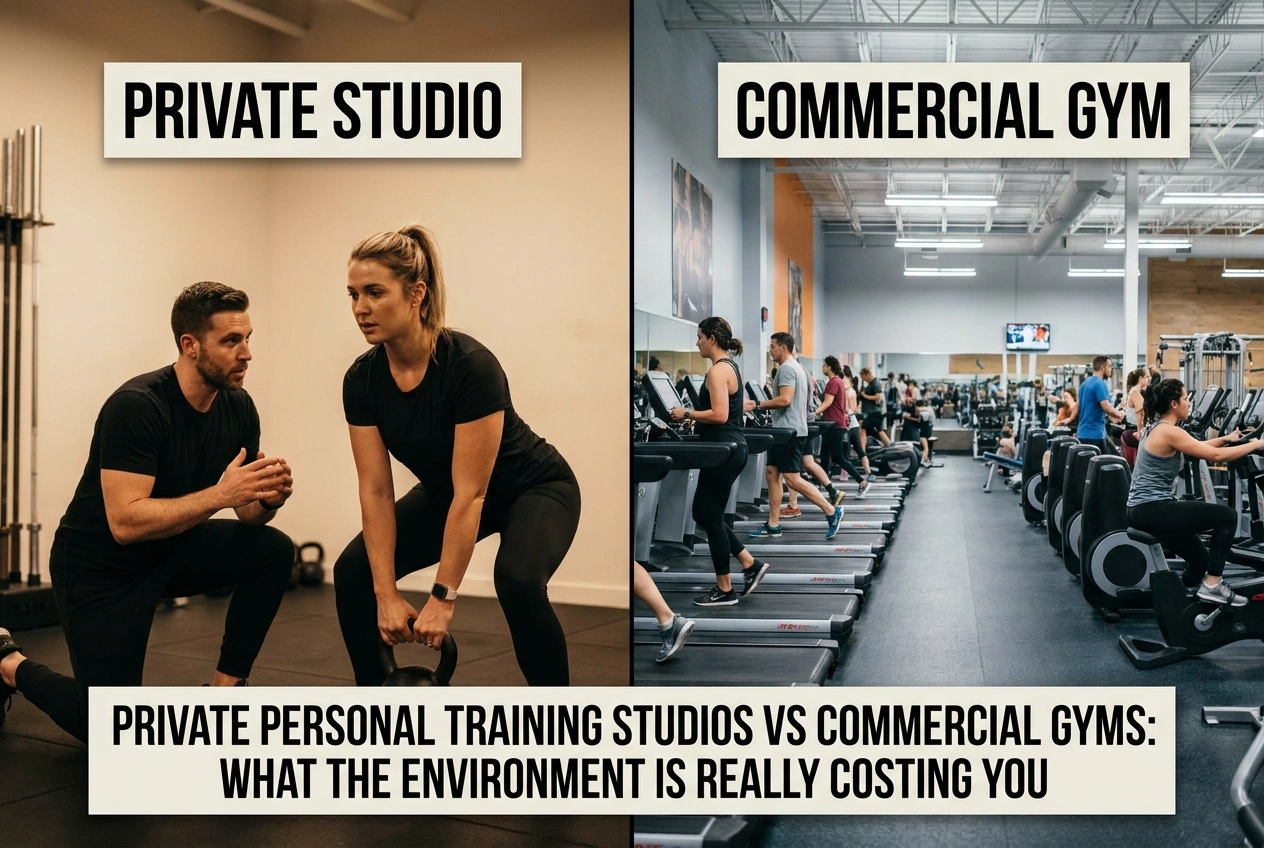
Most people choosing between a commercial gym and a private personal training studio frame it as a budget decision. They compare monthly fees, weigh the amenities, and conclude that paying more for a private setup is a luxury reserved for athletes or executives with deep pockets. That framing is costing them results they will never recover.
The environment where you train is not a backdrop. It is an active variable that shapes every outcome you are working toward: your focus, your trainer’s ability to coach you properly, your access to the right equipment at the right moment, and your psychological readiness to push hard. Change the environment and you change the training, regardless of who is standing next to you.
This post makes a direct, evidence-based case for why the environment itself determines training quality. You will see how commercial gyms are structurally designed against your progress, what distraction and equipment delays actually cost in measurable terms, and why clients training in private studios report higher satisfaction and stronger long-term adherence than those in public gym environments. By the end, you will have a clear framework for deciding where you should be training and why.
The Environment Is a Training Variable, Not a Preference
Most people who plateau blame their programme. Some blame their effort. Almost no one examines the environment those things are operating inside.
Distraction, equipment availability, social pressure, and the trainer’s capacity to focus exclusively on one client are all functions of the setting, not the coach. A trainer’s skill is largely fixed from session to session. The environment is what either amplifies or undermines that skill in real time.
Research published in the NIH’s training monitoring literature identifies cognitive demand as a measurable training variable that belongs in the monitoring process alongside physical load. Environments that generate high cognitive noise, through crowding, noise, and unpredictable equipment access, impose a measurable tax on every session, independent of how well the programme was written or how hard the client works.
Choosing between a private personal training studio and a commercial gym sets the ceiling on your outcomes before a single rep is performed, and the sections that follow isolate precisely why.
Commercial Gyms Are Engineered for Volume, Not Results
The business model explains everything you experience on the floor.
Commercial gyms carry thousands of members per location, and profitability depends structurally on members who pay but rarely show up. The gym does not need you to attend consistently; it needs you to keep paying. That misalignment between the business model and your training consistency is not incidental, it is foundational.
Membership pricing of $10–$50 per month is calibrated to minimise friction at sign-up, not to attract people with serious training intentions. Low entry barriers produce a correspondingly low-commitment floor culture. The community inside the facility reflects the pricing strategy that built it.
Peak-hour crowding between 5–7 PM and on weekend mornings is the direct, predictable consequence of that volume model. Every member who signed up expecting to use those hours is competing for the same equipment simultaneously. This is not a scheduling inconvenience you can optimise around; it is a structural outcome of how the business operates.
For anyone running circuits or supersets, sequenced equipment access is not a preference, it is a programming requirement. During peak hours, that requirement cannot be met. Equipment wait times and phone-occupied stations mean the precision that separates institutional-grade programming from improvised training gets abandoned the moment a cable station is taken.
The facility design, equipment layout, and floor culture are built for the average member. There is no configuration of this model that prioritises your session, because your session is one of thousands the model was never designed to serve individually.
Distraction Is Not Trivial: What Interrupted Sessions Actually Cost
Distraction does not simply pause performance, it degrades it. Research on task-switching shows that interruptions compound across a session, fragmenting attention in ways that undermine both the trainer’s ability to coach and the client’s capacity to execute. A trainer navigating a busy gym floor is managing exactly this kind of fragmented attention state, regardless of their qualifications or preparation.
The environmental constants in a commercial setting compound this. Phone use, unsolicited conversation, occupied equipment, and ambient noise are not occasional disruptions; they are structural features of the floor. A personal trainer operating in these conditions spends a measurable portion of each session on logistics rather than on you. The session that was planned and the session that gets delivered are not the same thing.
Private personal training studios remove this variable by design. Controlled access, capped membership, and a floor culture oriented around focused training mean the session structure survives contact with reality. The programme executed is the programme that was built for your goals, not a reduced version assembled around what happened to be available.
Psychological Safety Is a Performance Variable Most People Never Name
Self-consciousness on a busy commercial gym floor is not a personality flaw. It is a predictable physiological response to being observed by strangers while under physical stress, attempting unfamiliar movements, or working through visible struggle. The environment produces that response reliably, regardless of the individual.
The consequences rarely appear in a training log. Clients who feel watched will subconsciously reduce their effort ceiling. They will avoid the movements they most need to develop because those movements expose what they cannot yet do. On lower-confidence days, they will skip the session entirely. None of this registers as a missed set. All of it registers as slower progress and stalled outcomes.
Personal gym training in a private studio restructures this entirely. A membership capped at 100 to 200 people creates a known community rather than a rotating audience of strangers. One-to-one sessions remove the audience completely. The social conditions of the session become a controlled variable rather than an ambient threat.
For specific populations, this is not a comfort consideration. People returning from injury, those beginning structured training for the first time, and adults managing weight or body image concerns require psychological safety as a baseline condition for consistent attendance and full-effort work. Without it, adherence fails before programming ever gets the chance to deliver.
This is where the environment directly constrains the trainer. A coach operating in a psychologically safe environment controls the social conditions of every session. A coach on a commercial gym floor does not, regardless of their skill or intentions.
Equipment Access Is Not a Convenience Issue, It Is a Programming Issue
Psychological safety determines whether you show up and give full effort. Equipment access determines whether the session that effort goes into is actually the session your trainer designed.
Every structured programme is built around specific equipment sequences. When a required piece is occupied, the trainer substitutes, and that substitution is not a minor adjustment. It is a deviation from the stimulus your programme was designed to produce. Repeat that across multiple sessions and the programme you are paying for exists only on paper.
In a private personal training studio, the equipment your session requires is available because the facility is not shared with hundreds of other members during your training time. The programme that was designed for your goals is the programme that gets executed, without on-the-fly modifications driven by floor logistics.
The same programming logic extends beyond individual exercises to rest interval control and recovery infrastructure. Controlled rest periods regulate training stimulus, metabolic demand, and neuromuscular fatigue. A trainer waiting for equipment to free up cannot hold a 90-second rest interval with any precision. That lost control is lost stimulus specificity. Recovery infrastructure, saunas, massage tables, dedicated recovery areas, supports the adaptation process the training session initiates. These are standard in well-equipped private facilities and largely absent from commercial gyms.
The McLeod Method operates within a private gym environment with a deliberately limited client base, precisely so that equipment, space, and trainer attention are fully available for every session. The planning investment reaches the floor intact.
The Real Cost Comparison: Price Per Hour vs Cost Per Result
All of this compounds into a financial question that most people calculate incorrectly.
Private studio personal training rates are materially higher than commercial gym rates per session, and that gap is precisely what the cost-per-result framework must justify.
Commercial gym memberships cost $10–$50 per month. But the relevant figure is not your monthly spend; it is what each session actually delivers in terms of uninterrupted trainer attention, executable programming, and conditions that make consistent attendance realistic.
Adherence is the most determinative variable in long-term training outcomes, outweighing programming precision, nutrition timing, and supplementation. Research consistently links private, supervised training environments to higher satisfaction and adherence than public gym settings. A programme you consistently complete at a higher hourly rate produces more results than an optimised programme you partially execute at a lower one.
The cost-per-result framing changes the comparison entirely. Lower hourly rates attached to reduced adherence, compromised session execution, and distraction-limited trainer focus may produce a higher cost per successful outcome than a private studio rate that delivers the full session, every time.
What the Private Studio Model Actually Enables
The value case has been made. What the private studio model delivers on top of that value is worth naming precisely.
A private personal training studio is not a better-appointed version of the same service. It is a structurally different model, one where the environment is designed as part of the methodology rather than as the backdrop to it. The facility, the session structure, and the service offerings are built to function as a single system.
That integration matters practically. Personalised programming, sports massage, recovery support, and nutrition guidance operate cohesively in a private studio because the trainer controls the full environment. In a commercial gym, those services are layered onto a setting that was never designed to support them. Recovery work between a massage table and the training floor becomes fragmented; nutrition guidance has no environmental reinforcement; the session ends and the client re-enters a facility optimised for volume, not adaptation.
The limited client model resolves this. At The McLeod Method, every session is planned against the specific conditions it will be delivered in. The programme and the execution match.
That consistency creates a feedback loop that commercial environments structurally break. The trainer observes every rep under controlled conditions, adjusts in real time without environmental interference, and carries accurate session data directly into the following week’s planning. Progressive overload, technique refinement, and load management all depend on that data being clean.
Who Should Train Where: An Honest Assessment

The right environment for your training is a function of what you actually need from each session, not a matter of preference.
Commercial gyms serve a genuine purpose. A self-directed, experienced trainee who knows their programming, can train outside peak hours, and has no requirement for oversight will find a commercial gym fit for purpose. The equipment range is broad, access is flexible, and cost is low.
The model breaks down the moment any of those conditions change. If your goals require specific outcome targets within a defined timeline, training around injury or a health condition, or consistent attendance that has previously proved difficult, the structural supports needed simply are not present in a commercial gym environment.
A personal trainer working from a private studio is not delivering the same service as one operating on a commercial gym floor. The environment determines what the trainer can actually execute: the session they planned, the adjustments they can make in real time, and the attention they can direct without interruption. Identical qualifications produce materially different outcomes when the setting changes.
The deciding question is not which environment feels more appealing. It is which environment eliminates the variables most likely to derail your goals. For most people investing in structured personal training, those variables are distraction, inconsistency, and sessions that do not run as designed.
When the goal is results, the private studio is not an upgrade. It is the baseline condition under which serious training becomes possible.
What to Do Next
Once you have identified which environment your training actually lives in, the next step is a direct audit. Assess four variables honestly: the distraction level during your sessions, whether the equipment your programme requires is available when you need it, whether your trainer’s attention is genuinely undivided, and whether you feel psychologically safe enough to train at full effort.
If you are investing in personal training and the results are not proportionate to that investment, examine the environment before you examine the trainer. The setting may be the limiting factor, not the coaching quality.
When evaluating private personal training studios, prioritise those built around limited client numbers, meticulous session planning, and full environmental control. These are not premium features. They are the structural conditions under which personal training investment actually converts to measurable outcomes.
The McLeod Method operates with a limited number of individuals within a private gym environment, delivering training, sports massage, and recovery support through planned, precisely executed sessions. Every variable covered in this piece, including distraction, equipment access, trainer focus, and psychological safety, is controlled by design.
If you are ready to train in conditions built entirely around your results, this is the starting point.
Conclusion
The environment where you train is not a background detail. It is an active variable that either compounds or undermines every coaching decision made on your behalf.
The case comes down to four points that have been established above: distraction degrades performance regardless of motivation; equipment availability shapes what programming is even possible; undivided trainer attention is a non-negotiable for genuine progress; and psychological safety determines how hard you are truly able to push.
Personal training investment only delivers proportionate returns when the structural conditions support it. Price per session means nothing if the environment is working against the result.
If your current setup cannot honestly pass that four-point audit, the environment deserves scrutiny before anything else does.
You have put serious investment into your training. Make sure the space around it is working just as hard. The right environment does not just support your results; it accelerates them.