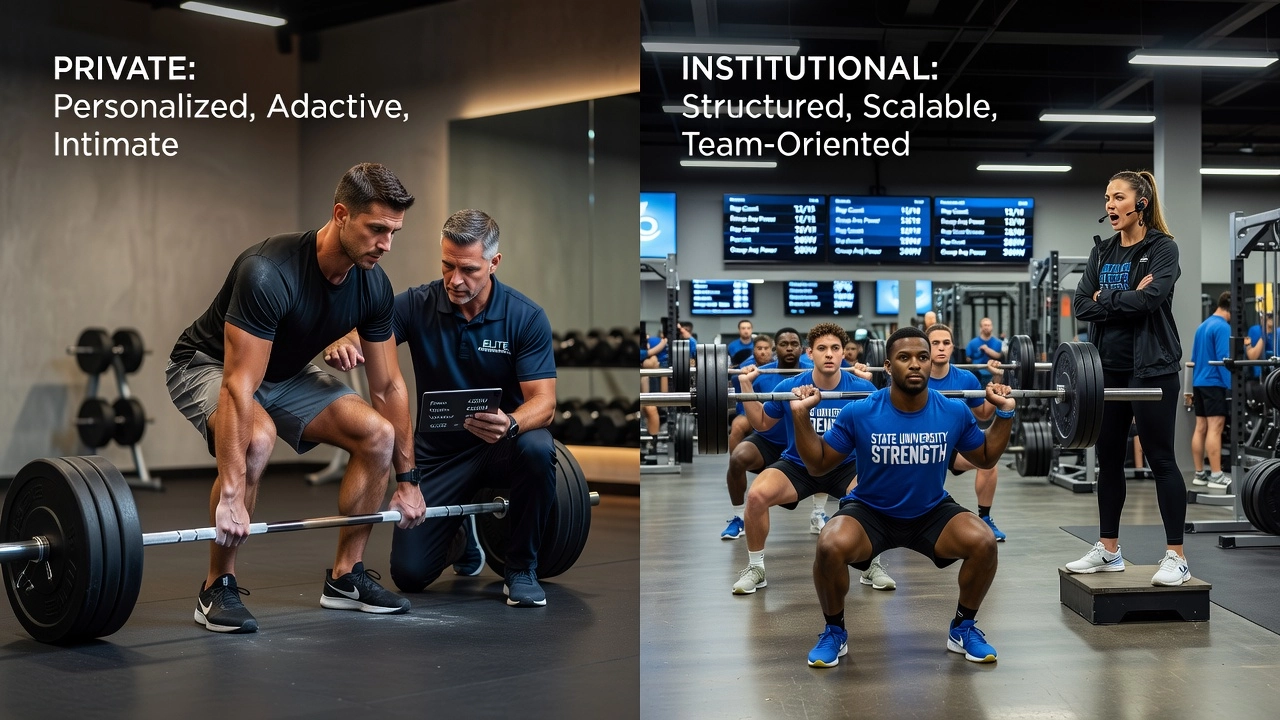
Whether you are an aspiring athlete or someone serious about leveling up your performance, finding the right strength and conditioning coach can make or break your progress. But here is a question that does not get asked enough: should you work with a private coach or pursue training through an institutional setting like a university, professional sports organization, or corporate gym?
The answer is not as straightforward as it might seem. Both paths come with distinct advantages, trade-offs, and ideal use cases that depend heavily on your goals, budget, and current stage of development. Choosing blindly could mean wasting time, money, and effort on a setup that simply does not align with your needs.
In this post, we are breaking down the key differences between private and institutional strength and conditioning coaches. You will get a clear look at the training environments, coaching quality, cost considerations, and career implications tied to each option. By the end, you will have the knowledge to make a confident, informed decision about which route is right for you.
What a Strength and Conditioning Coach Actually Does
A strength and conditioning coach is a specialized performance professional who designs, delivers, and monitors evidence-based training programs to enhance physical capabilities across multiple domains. The core role encompasses improving strength, speed, power, agility, injury resilience, and recovery capacity through periodized programming grounded in exercise science, biomechanics, and physiology. Every program is built around measurable outcomes, with ongoing assessment and data tracking used to refine training loads, identify weaknesses, and ensure consistent progress over time.
The distinction between an S&C coach and a general personal trainer is meaningful and worth understanding clearly. Personal trainers typically serve the broader population with generalized programming focused on health, aesthetics, or basic fitness. S&C coaches operate at a deeper level, applying advanced periodization models, long-term athletic development frameworks, and rigorous performance monitoring to drive specific physical adaptations. The Science for Sport resource on S&C coaching outlines how this specialization demands a distinct knowledge base, often validated through credentials like the NSCA Certified Strength and Conditioning Specialist qualification.
S&C coaches operate across a wide range of environments, from professional sports franchises and university athletic departments to commercial gyms and private practice settings. Private practitioners, in particular, bring a level of individual attention and bespoke programming that team-based roles rarely allow, integrating recovery modalities, nutrition timing, and movement quality as standard components rather than afterthoughts.
The field has evolved considerably beyond its performance-only origins. According to industry data referenced by the NSCA, broader fitness coaching roles are projected to grow by 26 to 39 percent through 2030, reflecting surging demand for qualified, specialized practitioners who bring genuine expertise to every aspect of a client’s physical development.
The Two Coaching Models: How They Are Structured
Not all strength and conditioning coaches operate within the same structure, and that distinction matters enormously when you are deciding where to invest your training. Two primary models define the profession: the institutional model and the private model. Understanding how each is built will help you assess which environment is genuinely suited to your goals.
The Institutional Model
The institutional model places coaches inside team or facility-based settings, typically high schools, universities, professional sports organizations, or large performance centres. In these environments, a single coach may oversee anywhere from 30 to 100 or more athletes simultaneously, particularly during peak training phases in collegiate Division I programmes. Because of this scale, programming tends to rely on group periodization blocks structured around competition calendars or facility availability rather than individual need. Standardized templates allow coaches to manage large rosters efficiently, but they necessarily limit how much a programme can flex around any one person’s biology, recovery status, or life demands. Administrative responsibilities, equipment oversight, and coordination with sport coaches further compress the time available for direct athlete attention.
The Private Model
The private model operates on fundamentally different logic. Client rosters are kept deliberately small, and every session is built around the individual rather than adapted from a group blueprint. This structure enables fully bespoke programming that accounts for movement history, injury background, daily schedule, and personal goals from the outset. Direct, ongoing accountability between coach and client becomes possible when the relationship is not diluted across dozens of athletes. The McLeod Method reflects this philosophy precisely, working with a strictly limited number of clients to ensure that session quality is never compromised by volume.
Programming Depth and Real-Time Accountability
The practical difference in programming depth between these two models is significant. Institutional coaches face genuine structural barriers to individualization, including rigid scheduling windows and the logistical reality of managing large groups, which means programme adjustments typically occur at scheduled review points rather than continuously. In a private model, adjustments happen session to session, informed by recovery data, life stress, and performance feedback gathered in real time. If sleep was poor, load shifts. If stress is elevated, intensity adapts. This level of responsiveness is structurally unavailable in high-ratio environments, regardless of a coach’s expertise or intent.
Meticulous Programming: What Genuine Personalisation Looks Like
Truly individualised programming begins long before a single repetition is performed. A meticulous strength and conditioning coach conducts structured movement screening, such as a Functional Movement Screen, to identify asymmetries, mobility restrictions, and stability deficits that would otherwise be ignored in a generic plan. This assessment, combined with a thorough review of training history, past injuries, and individual responses to different loading stimuli, forms the structural foundation of every programme. Lifestyle factors carry equal weight: sleep quality, stress load, nutritional habits, and occupational demands are not peripheral considerations but active variables that shape session design from the outset. Goal hierarchies then determine the overarching direction, ensuring that exercise selection, periodisation, and session priorities all serve a coherent, client-specific outcome rather than a borrowed template.
The Problem With Cosmetic Customisation
Templated programming, common across commercial gym environments and many online coaching platforms, applies a shared structural framework to a broad population with only surface-level adjustments. Swapping a barbell press for a dumbbell variation or changing a rep range by two does not constitute genuine personalisation. The underlying architecture, including volume distribution, intensity progression, and recovery sensitivity, remains identical regardless of who is performing it. This approach consistently produces stalled progress and elevated injury risk because the programme cannot respond to individual recovery capacity or movement limitations. When a client plateaus in a group or facility-based setting, it is rarely a motivation problem; it is a programming sensitivity problem. The stimulus stops being appropriate the moment it stops being specific.
Objective Data, Real Adjustments
Premium private coaching integrates data-driven tools to replace guesswork with evidence. Wearables tracking heart rate variability, sleep quality, and daily readiness provide objective input before the session begins. Velocity-based training metrics add another layer of precision during sessions, with bar speed data revealing fatigue states that perceived exertion alone would miss. When velocity drops below an established threshold, load or volume is adjusted in real time rather than following a pre-set number that ignores how the athlete actually presents that day. Research into personalised training approaches confirms that this kind of responsiveness produces measurably superior outcomes in strength, body composition, and adherence compared to standardised methods.
The Compounding Value of Documentation
Session-by-session documentation transforms individual data points into strategic intelligence over time. A private coach recording loads, velocities, readiness scores, movement quality notes, and subjective feedback across months begins to recognise patterns that would be entirely invisible in a high-volume setting: the correlation between disrupted sleep and a consistent velocity drop on compound lifts, or the gradual fatigue accumulation preceding a potential overuse issue. These insights allow proactive periodisation adjustments rather than reactive responses to injury or burnout. The benefits of this personalised, ongoing approach compound progressively, meaning clients working within a genuinely individualised model continue to improve long after those in templated environments have stalled. In a private setting with a limited client load, this level of detail is not just possible; it is the standard.
Why Recovery Integration Separates Good Coaching from Great Coaching
Training creates the stimulus for change, but the adaptation itself occurs entirely during recovery. This is not a minor distinction; it is the physiological foundation upon which all effective strength and conditioning programming must be built. When muscles experience mechanical stress and metabolic fatigue during a session, the body responds by repairing and rebuilding to a higher baseline, a process known as supercompensation. That process unfolds between sessions, during sleep, and through deliberate recovery interventions. A coach who treats recovery as an optional extra is, in effect, leaving the most important phase of the training cycle unmanaged.
This understanding has shifted how leading practitioners approach programme design. Recovery is now treated as a non-negotiable programming variable, integrated into periodisation plans with the same rigour applied to load, volume, and intensity. Soft tissue work sits at the centre of this shift. Sports massage embedded directly within a coaching plan improves circulation, reduces residual muscle tension, and accelerates the clearance of metabolic waste products. Research indicates massage can reduce delayed-onset muscle soreness by approximately 30% in the critical 24 to 48 hours post-session, restoring range of motion and improving readiness for subsequent training. When a coach controls both the training stimulus and the recovery response, they can time soft tissue interventions precisely, scheduling massage after high-load sessions or before technically demanding work to optimise tissue quality and output.
The problem most clients face is that these elements are handled by entirely separate providers. Training with one professional, massage with another, and nutrition guidance from a third creates a fragmented experience where no single person understands the full picture. Conflicting recommendations, poor communication between providers, and gaps in accountability are common consequences. The training stress that produces chronic tightness in one session goes unaddressed because the therapist seeing that client three days later has no context for the specific loading pattern that caused it. This is precisely why recurring tightness and low-grade injuries persist for many well-intentioned athletes; the root cause is never connected to the stimulus producing it.
The integrated model resolves this directly. The McLeod Method operates on this principle, combining personalised strength training with sports massage and recovery support within a private setting. Every session is coordinated so that soft tissue work responds directly to the demands placed on the body during training. Tightness identified from a specific movement pattern can be addressed immediately, correctives can be embedded, and the next session planned with accurate knowledge of current recovery status. This single-point coordination eliminates the communication gaps of fragmented care and ensures recovery work supports rather than operates independently of the training stimulus. For clients who have cycled through temporary relief without lasting resolution, this joined-up approach represents a genuinely different outcome.
Beyond Reps and Sets: Nutrition, Movement, and Wellness in Modern S&C
Client expectations have shifted considerably in recent years. Where performance metrics and periodised loading once defined the scope of a strength and conditioning coach’s role, today’s intermediate and advanced clients arrive with far broader demands. According to NASM’s industry research on fitness trends, growing numbers of clients now seek coaches who address nutrition timing, hormonal health, breathwork, and movement quality as integral components of their programme, not optional extras bolted on afterward. This shift reflects a deeper understanding of how the body actually adapts, and it places coaches who can integrate these elements in a position of considerable advantage.
Nutrition guidance embedded directly into a training plan produces measurably different outcomes than generic dietary advice. When carbohydrate and protein availability are matched to specific training demands, the body has the substrate it needs to drive muscle protein synthesis, sustain energy availability, and support hormonal function. Chronically low energy availability impairs adaptation, elevates injury risk, and can suppress resting metabolic rate, even in clients who are actively trying to improve body composition. Periodised nutrition, calibrated session by session, resolves this by aligning intake with output in a way no standardised eating template can replicate.
The longevity and functional fitness trend reinforces this integrated approach. ACSM’s 2026 fitness trend data confirms that clients are increasingly training for healthspan across life stages rather than short-term performance peaks. Muscle preservation, joint resilience, movement quality, and metabolic health have become primary goals. Clients want to perform well at 55 and at 70, which demands programming built around sustainability, not intensity cycles that peak and crash.
This is precisely where a holistic private coach holds a structural advantage over institutional models. Large-scale settings prioritise volume and standardised protocols. They lack the capacity to account for a client’s sleep quality that week, elevated cortisol from work stress, or hormonal shifts that alter recovery demand. A private strength and conditioning specialist can observe, adapt, and integrate these factors in real time, addressing the whole person rather than a training variable in isolation.
That depth of service commands corresponding investment. While average S&C coaches earn between $45,000 and $67,000 annually, private specialists offering integrated wellness support consistently reach $78,000 or above. The premium reflects not just additional services, but demonstrably better outcomes and stronger client retention across the long term.
Which Coaching Model Is Right for You?
Choosing between coaching models is rarely about prestige or price. It comes down to an honest assessment of where you are, what you need, and what has or has not worked for you previously.
When the Institutional or Team-Based Model Makes Sense
The institutional model delivers genuine value for specific populations. Competitive team athletes embedded within collegiate or professional environments benefit from access to shared facilities, integrated medical staff, and sport-specific group culture that private settings cannot replicate. Individuals early in their training journey also thrive here; the structured environment provides foundational exposure to movement patterns, loading principles, and consistent routine without the pressure of advanced individualisation. If your primary driver is group accountability, social energy, or the motivational pull of training alongside peers working toward similar goals, the team-based setting is well-matched to those needs. It is accessible, community-oriented, and effective when goals remain broad.
When Private S&C Coaching Becomes the Stronger Choice
The calculus shifts considerably once you have outgrown generic programming. Committed individuals who have followed structured plans for a year or more but find progress stalling are often experiencing the limits of high-volume, one-size-fits-all design rather than a failure of effort. Busy professionals face a different challenge: their recovery capacity, sleep quality, and available training windows fluctuate week to week, and a programme that cannot flex around those realities becomes counterproductive. For anyone managing recurring soft tissue injuries, persistent movement compensations, or performance plateaus that multiple programmes have failed to resolve, private strength coaching provides the depth of analysis and ongoing adjustment that institutional settings structurally cannot offer.
Addressing the Investment Question Honestly
Private coaching commands higher session rates, and that reality deserves a direct response rather than a deflection. The more useful calculation is cost per outcome rather than cost per session. A client who spends two years cycling through generic programmes, accumulating minor injuries, and repeating ineffective training blocks is not saving money by choosing the cheaper option. The wasted time, the injury downtime, and the slower trajectory represent a significant hidden cost. When private coaching eliminates those cycles and accelerates measurable progress, the financial comparison often favours the higher-rate model over any meaningful timeframe.
Reading Your Own Self-Selection Signals
The questions you find yourself asking are a reliable indicator of which model fits. If you are asking why a particular exercise is programmed, why your numbers have stalled despite consistent training, or how your sleep and nutrition are interacting with your performance, you are already thinking in the language of individualised coaching. Clients who have moved through multiple gyms or training programmes without sustaining results are not uncommitted; they are simply operating in environments that were not built with their specific needs in mind. That pattern is one of the clearest signals that a private model is the appropriate next step.
The right model is not always the most expensive one. Institutional and group settings deliver real value for accessibility, foundational development, and social motivation. However, for the client who values precision in programming, privacy in the training environment, and genuine integration of training, recovery, and lifestyle factors, the private approach removes the compromises that are simply unavoidable in high-volume settings. The question worth asking is not which model costs more, but which model is actually solving the problem you have.
The McLeod Method: How a Private S&C Coach Operates in Practice
The principles outlined throughout this article find their clearest expression in one specific operational reality: deliberate limitation of client numbers. The McLeod Method works with a strictly limited number of individuals at any one time, and this is not a business constraint. It is the foundation upon which everything else is built. When caseload is capped, the depth of planning, speed of responsiveness, and quality of attention that each client receives becomes genuinely possible. Session modifications based on fatigue levels, programme adjustments triggered by a difficult week at work, or recovery interventions prompted by a niggling injury can all happen immediately, without compromise.
The private gym environment reinforces this further. There are no queues for equipment, no background noise competing with coaching cues, and no structural compromises forced by sharing space with other programmes. Each session unfolds exactly as designed, at the intended intensity, with full focus maintained from warm-up through to the final recovery phase. This consistency in session environment is more significant than it might first appear; when the physical space is controlled and predictable, the coaching quality within it can operate at its ceiling.
What distinguishes The McLeod Method from even high-quality conventional coaching is that training delivery, movement quality, sports massage, recovery support, and nutritional guidance are not separate services selected from a menu. They function as a single, unified protocol. The load from Tuesday’s session informs Wednesday’s nutritional recommendations. Sports massage is scheduled in direct response to training stress, not as an optional add-on. Movement screening findings shape every warm-up structure. The services are interdependent by design.
Every session is planned in advance with the client’s current physical status, recent training history, and upcoming life demands fully considered. This is what elite private strength and conditioning coaching looks like when it is operating without compromise.
Choosing a Strength and Conditioning Coach: Key Takeaways
The model you choose as your strength and conditioning coach determines far more than session quality. It determines whether your training, recovery, and nutrition operate as a coherent, reinforcing system or pull against each other in separate directions. That structural reality is the central distinction this article has examined throughout.
Private S&C coaching is not a luxury upgrade on a familiar service. It is a categorically different model with meaningfully different outcomes for the right client. When programming, soft tissue recovery, and nutritional strategy are designed and delivered by the same practitioner with full context, the results compound in ways that fragmented support simply cannot replicate.
Your actionable next step is straightforward: assess your current setup honestly. Where are the gaps in your programming consistency, recovery integration, or nutritional alignment? Identifying those gaps clearly is the first productive move.
If what you have read reflects where you currently are, exploring The McLeod Method through a direct consultation is a logical and worthwhile next step.
Conclusion
Choosing between a private and institutional strength and conditioning coach comes down to knowing yourself and your goals. Private coaches offer personalized attention, flexible scheduling, and a tailored approach that adapts directly to your needs. Institutional coaches bring structured programming, team resources, and credibility that can open doors in competitive environments. Neither option is universally superior; the right choice depends on your current stage, budget, and long-term vision.
Now that you understand the key differences, take action. Audit your goals, assess your resources, and honestly evaluate which environment will push you to perform at your highest level. Do not leave your development to chance or convenience.
The right coaching relationship is one of the most powerful investments you can make in your athletic future. Choose with intention, and the results will follow.