Whether you are dealing with chronic back pain, recovering from an injury, or simply carrying too much tension in your muscles, you have likely heard the term “remedial massage” thrown around. But what does it actually mean, and how is it different from a regular relaxation massage?
Understanding the remedial massage meaning is the first step toward making informed decisions about your health and recovery. Unlike a standard spa massage, remedial massage is a targeted, therapeutic treatment designed to identify and address the root cause of muscular pain and dysfunction. It is grounded in anatomy and physiology, making it a genuinely clinical approach to soft tissue therapy.
In this guide, you will learn exactly what remedial massage is, how it works, and what you can expect during a session. We will also break down the key techniques used by therapists and explain who can benefit most from this type of treatment. By the end, you will have a clear, confident understanding of remedial massage and whether it might be the right option for you.
The Plain-English Definition of Remedial Massage
Remedial massage is a targeted therapeutic intervention designed to assess, treat, and manage dysfunction in the muscles, tendons, and ligaments. It is not a spa service, a relaxation treatment, or a generalised wellness experience. According to Healthdirect Australia, remedial massage is used to treat muscles that are damaged, knotted, tense, or immobile, with the therapist working to identify and address the underlying cause of pain rather than simply relieving surface-level discomfort.
The word “remedial” is the critical clue. It derives from the concept of remedy, meaning to correct or cure. That etymology directly explains why the modality is goal-directed rather than comfort-directed. A remedial massage therapist works toward specific clinical outcomes: pain relief, injury rehabilitation, or the restoration of functional movement. The session is built around what is found during an initial assessment of posture, range of motion, and muscle imbalances, not a standard routine applied uniformly to every person who walks through the door.
This is the defining distinction between remedial massage and Swedish or relaxation massage. As detailed in this overview of remedial massage benefits and techniques, relaxation massage is experience-driven, ending when the client feels better in the moment. Remedial massage is outcome-driven; the session ends with measurable progress toward a defined clinical goal. One treats sensation, the other treats dysfunction.
As of 2026, remedial massage therapy is one of the most widely adopted approaches for managing muscular pain and dysfunction, applied across sports, rehabilitation, and general wellness settings globally. Its integration into multidisciplinary care reflects a broader shift toward personalised, assessment-led treatment rather than one-size-fits-all approaches.
Why Remedial Massage Has Been Around for Thousands of Years
Therapeutic massage is not a modern invention. Documented evidence of its use as a treatment for illness and injury stretches back thousands of years across multiple civilisations. Egyptian hieroglyphics from as early as 2330 BCE depict hands-on bodywork. Ancient Chinese medicine incorporated tui na massage as a core healing practice. Homer’s Iliad references massage with oils to treat the wounds of warriors. These were not indulgences; they were interventions, applied with therapeutic intent by practitioners who understood that working soft tissue produced measurable physical results.
Hippocrates, widely regarded as the father of modern medicine, formalised this understanding. He specifically advocated rubbing and friction for musculoskeletal ailments, establishing the foundational principle that manual therapy can influence tissue function and repair. That idea, written centuries before clinical trials existed, remains the basis of remedial massage today.
It is worth being honest here. A 2008 review published in PMC noted that while massage use has been continuous across millennia, robust clinical research is a relatively recent development. The practice predates the science. Acknowledging that distinction is not a weakness; it is what separates credible therapeutic work from unsubstantiated claims.
What has changed is structure. Modern remedial massage has evolved from these ancient roots into an assessment-led, clinically reasoned discipline with defined techniques, documented outcomes, and integration into multidisciplinary care teams. Understanding this history clarifies why the term sounds clinical. It always was. Remedial massage was never designed as a luxury. It was designed as a remedy.
Remedial Massage vs. Sports Massage: What Is Actually Different?
Sports massage is purpose-built around movement. Where remedial massage addresses the broader musculoskeletal system, sports massage targets the specific muscle groups most engaged in an individual’s sport or physical activity. The orientation is movement-specific: a runner’s session looks different from a swimmer’s, which looks different again from someone training in the gym three times a week. This focus on activity-driven demand is what separates sports massage conceptually from its remedial counterpart.
The three core goals of sports massage are clearly defined: preventing injury before it occurs, supporting recovery from injury when it does, and accelerating recovery from training and general physical activity. According to research published in the North American Journal of Sports Physical Therapy, sports massage is commonly applied across pre-event preparation, active performance phases, and rehabilitation, though the authors note the evidence base warrants further development. The clinical categories are well established even where individual study outcomes vary.
Where the Two Modalities Actually Overlap
The hands-on toolkit used in both approaches is largely the same. Deep tissue work, trigger point therapy, and myofascial release appear in both remedial and sports massage sessions. As Spinal and Sports Care notes, the meaningful distinction lies in clinical intent and the depth of initial assessment, not in the physical techniques applied during the session.
Remedial massage tends to front-load its process with comprehensive postural evaluation and range-of-motion testing before any hands-on work begins. Sports massage can be more reactive and session-specific, calibrated to where someone sits in their training schedule on a given week.
In a one-on-one integrated setting, the label on the service matters far less than the quality of the outcome. The right blend of thorough assessment, appropriate technique, and structured planning is what produces results. Finally, you do not need to be a competitive athlete to benefit from either approach. Anyone who is regularly active qualifies for sports massage, and anyone carrying persistent muscular tension or postural load has legitimate cause for remedial treatment.
What a Remedial Massage Session Actually Involves
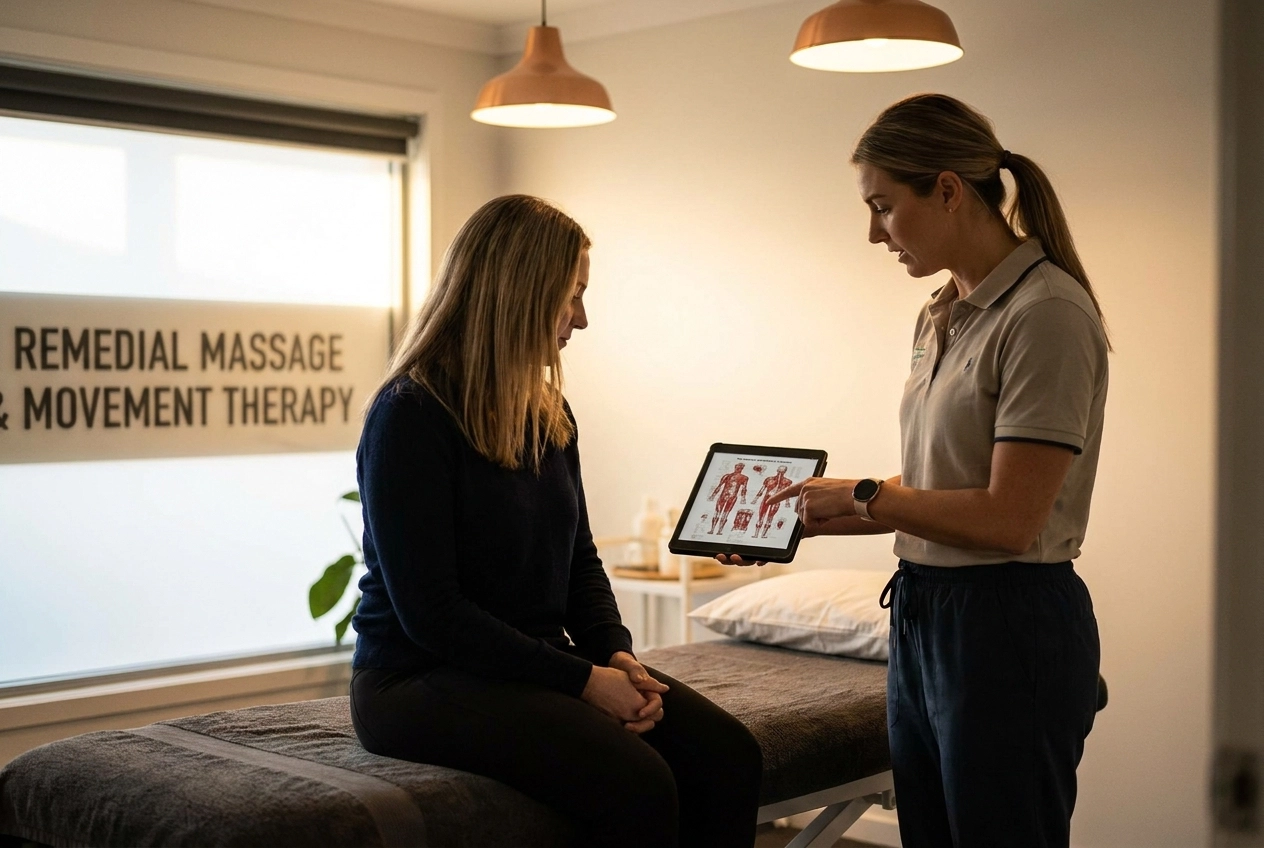
Every remedial massage session begins before any hands-on work takes place. The practitioner conducts a structured clinical assessment covering posture analysis, range of motion testing, and identification of muscle imbalances or compensation patterns. This intake process determines everything that follows: which areas are prioritised, which techniques are applied, and how much pressure is appropriate. It is this assessment phase that separates a remedial massage appointment from a generic massage, where technique is applied without any preceding evaluation of function or dysfunction.
Technique selection flows directly from what the assessment reveals. Deep tissue massage addresses chronic tension held in the deeper layers of soft tissue, working through surface musculature to reach the structures underneath. Trigger point therapy targets localised hypersensitive spots within taut bands of muscle and fascia, which can restrict blood flow and produce referred pain that travels well beyond the original site. Myofascial release therapy addresses the connective tissue network surrounding muscles and organs; fascia that has tightened following trauma or overuse loses its normal flexibility and becomes a source of pain and restricted movement. These techniques are not applied in a fixed sequence but are chosen deliberately based on what the tissue presentation demands on that day.
Working within a private gym environment adds a layer of clinical precision that a one-off clinic appointment cannot replicate. The practitioner carries accumulated knowledge of the client’s training load, movement history, and how tissue has responded to previous sessions. At the McLeod Method level, this means arriving at each session with a defined therapeutic intention, tracking tissue quality and functional improvements over time, and adjusting the approach as the client progresses rather than repeating the same protocol indefinitely.
Treatment does not end when the session concludes. Clients receive specific guidance on movement, stretching, or positional adjustments to reinforce the work completed on the table. Inactivity and postural habits are primary contributors to recurring tension and trigger point formation, so post-session guidance is a functional extension of the treatment itself, not an optional add-on.
What the Research Actually Shows About Remedial and Sports Massage
The most rigorous examination of sports massage to date comes from a 2020 systematic review and meta-analysis published in BMJ Open Sport and Exercise Medicine. The review analysed 29 randomised studies recruiting 1,012 participants and tested massage against seven distinct outcomes: strength, jump height, sprint, endurance, flexibility, fatigue, and delayed onset muscle soreness. The findings are worth understanding clearly before forming expectations about what remedial or sports massage can and cannot deliver.
What the evidence confirmed is meaningful. The review found small but statistically significant improvements in both flexibility and DOMS. This aligns directly with what regular massage recipients consistently report: reduced stiffness between sessions and a faster return to training capacity after hard efforts. A 2023 systematic review reinforced this pattern, noting that massage does not affect motor abilities except flexibility, while pain reduction and DOMS relief appear linked to reductions in creatine kinase and psychological recovery mechanisms.
What the evidence did not confirm is equally important. No statistically significant improvements were found in strength, sprint performance, jump height, endurance, or fatigue. A 2008 review described the broader evidence base as scarce and called for more rigorous research. The field has improved considerably since then, but honest practitioners still work within what is proven rather than overstating outcomes.
Practically, this means remedial massage is a high-value tool for tissue recovery, flexibility, and pain management. It complements training, nutrition, and sleep rather than replacing any of them. Practitioners who oversell performance gains are working outside the current evidence base, and that undermines the trust that good clinical work depends on.
Who Benefits Most from Remedial Massage Therapy
Remedial massage therapy is not reserved for a specific type of person or a particular level of physical ability. The population it serves is broad, and understanding where it applies most directly helps you determine whether it is the right intervention for your situation.
Athletes and active individuals at any training level are among the most obvious candidates. High training loads create cumulative tissue stress, including restricted range of motion, recurring tightness, and slower recovery between sessions. Remedial massage targets exactly these adaptations, working directly on the muscle groups and connective tissue carrying the greatest load.
Desk-based professionals represent an equally significant group. Sustained postural positions compress the neck, shoulders, and lower back in predictable patterns. The postural assessment built into every remedial session identifies these imbalances precisely, and the targeted release work that follows addresses them systematically rather than broadly.
People managing chronic muscular tension, tension headaches, or long-standing stiffness typically see meaningful improvement within a structured course of treatment. Massage therapy research documents beneficial outcomes across multiple pain syndromes, with mechanisms including enhanced vagal activity and reduced cortisol levels supporting recovery at a physiological level.
Post-surgical and post-trauma clients integrate remedial massage into rehabilitation plans to restore tissue mobility, address movement restrictions, and rebuild functional patterns progressively.
The conditions most commonly addressed include sports injuries, postural dysfunction, reduced flexibility, tension headaches, lower back pain, and delayed training recovery. Critically, none of these require elite athlete status to justify treatment. Benefits of massage therapy are well-documented across general populations, reinforcing that this is a widely applicable clinical tool.
Remedial Massage as Part of a Complete Recovery Plan
Remedial massage delivers its strongest results when it forms one part of a wider recovery strategy rather than functioning as an isolated appointment. The tissue work completed in any given session can be reinforced or directly undermined by what happens outside the treatment room: the training load carried into the following week, the nutritional choices made in the days after, and the movement habits repeated during daily life. Treating a session as a one-off fix, without addressing those surrounding factors, limits how far the results can go.
The connection between massage and movement coaching is particularly powerful. When postural imbalances or compensation patterns are identified on the treatment table, that information has immediate practical value in the gym. A tight hip flexor identified during assessment, for example, should feed directly into corrective exercise programming; without that feedback loop, the same pattern gets loaded and reinforced in training, and the next session starts from the same point. Integration between these two disciplines creates compounding progress rather than repeated maintenance.
Nutrition represents an equally significant and frequently overlooked component. Protein availability supports the repair of soft tissue after hands-on work. Hydration affects tissue pliability and recovery speed. Anti-inflammatory dietary patterns influence how the body responds to treatment at a cellular level. A practitioner who accounts for all three of these angles alongside the physical treatment can accelerate client outcomes considerably compared to tissue work delivered in isolation.
The McLeod Method is built around precisely this integration. Training design, sports massage, and recovery support are delivered by the same practitioner within a private gym environment, meaning that the person managing your tissue health also understands your training load, your movement patterns, and your recovery context. The information gaps that arise when these services are split across separate providers are removed entirely.
This joined-up model reflects the broader direction of musculoskeletal care in 2026, with clear clinical movement toward multidisciplinary approaches that combine massage, movement programming, and nutritional support. For anyone dealing with recurring pain, slow recovery, or persistent performance plateaus, the more useful question is not simply whether to book a massage; it is whether the entire recovery plan is coordinated enough to address what is actually driving the problem.
Putting It All Together: What Remedial Massage Means for Your Recovery
Remedial massage is not a firmer version of a relaxation treatment. It is an outcome-driven, assessment-led therapy with a clear clinical purpose: restore function, reduce pain, and support musculoskeletal health over time. The evidence supports its use for flexibility improvements and reducing delayed onset muscle soreness, and honest practitioners work within those boundaries rather than overpromising structural cures that the research does not yet support.
The strongest outcomes consistently come from integration. When remedial massage sits alongside considered training load management, movement quality work, and nutritional support, the results compound. Treated as a one-off appointment, its effects remain limited and short-term.
If you are dealing with chronic tension, postural pain, recurring sports injuries, or slow recovery between sessions, the most direct path forward is a one-on-one environment where massage is planned in coordination with your training, not scheduled separately from it.
Take one practical step now: assess whether your current recovery approach is integrated or fragmented. If your massage therapist, trainer, and nutritionist have never shared notes, discussed your training load, or aligned their recommendations, that gap is likely costing you progress. Coordinated care is not a luxury; it is the standard that produces lasting results.
Conclusion
Remedial massage is far more than a simple rubdown. It is a clinically informed, targeted therapy designed to uncover and treat the root causes of muscular pain, tension, and dysfunction. Unlike relaxation massage, it draws on a deep understanding of anatomy to deliver real, measurable results for conditions ranging from chronic back pain to post-injury recovery.
The key takeaways are simple: remedial massage is therapeutic, not just relaxing; it is tailored to your specific needs; it works by addressing underlying dysfunction rather than masking symptoms; and it is suitable for a wide range of people and conditions.
If you are ready to stop managing pain and start resolving it, booking a session with a qualified remedial massage therapist is your next step. Your body has the capacity to heal. Give it the right support.