
If you are trying to dial in your nutrition, the first question is often about protein. You see the powders and the shakers everywhere, but what if you prefer to eat real food? Here is the short answer: you likely need more protein than you think, but a shake is just a convenience, not a requirement.
Getting your protein for muscle recovery right is about the total amount you eat each day and how you spread it across your meals. While hitting a specific per-meal target helps, the real coaching skill is adjusting those numbers around your training load and appetite. In this post, we will move beyond the marketing to give you practical guidance. We will cover how to set your daily total based on your body mass, how to divide that total into meals, and where a supplement actually fits in. We will also look at the specific points where a coach would change your numbers and what this looks like across a real training week. By the end, you will know how to stop guessing and start fueling your recovery with confidence.
How Much Protein an Active Adult Needs: The Short Answer
Most active adults do well on 1.6 to 2.2 g of protein per kilo of body mass per day, spread across several spaced meals through the day. That’s the usable answer. The rest of this section explains where you sit in that bracket and why.
The daily bracket, not a single number
Treat that range as a planning bracket. Where you land inside it depends on three things: your body mass, your weekly training load, and whether you’re maintaining or building muscle. Round to a number you can actually hit. A lighter week or a deload sits lower in the same bracket with no habit change required.
The per meal working figure
Roughly 20 to 25 g of high quality protein per meal is the working figure, with a qualifier. A 2018 review by Schoenfeld and Aragon found muscle protein synthesis is maximised in young adults at that dose, but specifically for fast digesting protein without other macronutrients. Slower proteins and mixed meals may support use above that figure, so treat 20 to 25 g as a floor for planning, not a hard ceiling.
The thesis this piece hangs on
Total daily protein and how it’s distributed across the day do most of the recovery work. A shake is only a delivery method. Specific daily gram ranges should be tied to the ISSN position stand and the 2024 meta-analysis once full texts are checked, so treat the numbers here as coaching judgement until then.
What Protein Does in Muscle Recovery
Protein’s job in recovery starts with muscle protein synthesis: the process that repairs training damage and builds new contractile protein, staying elevated for hours after a session before drifting back toward baseline. Distributing protein across meals, including a dose before sleep, may optimise the total synthesis response across the day, according to GSSI sports science guidance. The 2018 review by Schoenfeld and Aragon noted that doses above 20 g increase amino acid oxidation, but not all amino acids meet that fate, which makes very large single doses inefficient rather than useless. Protein also does not work in isolation. Physical activity raises the capacity to use ingested protein, and reduced activity reduces muscle sensitivity to protein feeding. Because distribution across the day is the variable the evidence points to optimising, the rest of this piece is arithmetic and habit building, not product selection. You can see that coaching mindset in how a personal trainer in Melbourne should operate.
Step 1: Set the Daily Total From Body Mass and Training Load
Now that you know distribution is the lever, set the total. Take the 1.6–2.2 g/kg bracket from the previous section and multiply it by your body mass in kilos, then round to a number you can reliably hit.
Split the band by intent. Training hard four to six days a week and chasing muscle? Sit at the top. A lighter week, off season or deload sits lower, with no habit change, just a lower number.
Sanity check the total on a plate. Two eggs and Greek yoghurt, a chicken or fish serve, lentils and dairy across the day. If the target only works with multiple scoops and no meals, rebuild it.
Calorie context comes first. Total energy intake and protein target need to be considered together. A protein target only performs when the rest of the day is fed.
The per-meal caveat on population (young adults, fast-digesting protein) applies here too. Older clients, and anyone with a condition such as diabetes, needs separate, evidence specific guidance. In practice, these numbers are coaching judgement, not a cited finding.
Step 2: Divide the Total Across the Day
You’ve got your daily number. Now spread it across a consistent set of feeding occasions: usually three substantial meals plus one or two smaller protein-containing snacks, rather than stacking most of it into dinner.
Use the per-meal working figure as a floor, not a ceiling. As noted above, that threshold applies to fast-digesting protein without other macronutrients; mixed meals may accommodate more. Treat that as planning logic, not a proven rule.
For many people, shifting a full 20–30 g dose into the first meal of the day is the most practical single change available. In practice, spacing feeds roughly three to five hours apart avoids meals bunching at either end of the day.
The distribution logic here is coaching reasoning, not a cited finding: no source in the material directly compares food-based protein with protein powder. It is simply how I structure the day in practice. Next, we’ll look at where a shake actually earns its place.
Where a Muscle Recovery Protein Shake Fits in the Pattern
Once the pattern is set, a shake has a narrow job: it patches a meal that would otherwise land well under its protein floor. It is not the recovery mechanism.
It earns its place in three situations. A session finishing hours from your next real meal. A day when appetite caps how much food you can comfortably eat. An early start when cooking is unrealistic. If your recovery plan also includes hands-on work, this guide to sports massage vs deep tissue massage helps you choose the right treatment.
Otherwise, remember the equivalence: a muscle recovery protein shake works because of the amino acids it delivers. Whole-food sources that supply comparable essential amino acids in a similar dose can fill the same gap; the amino acid content and digestibility of the specific food determines whether it does.
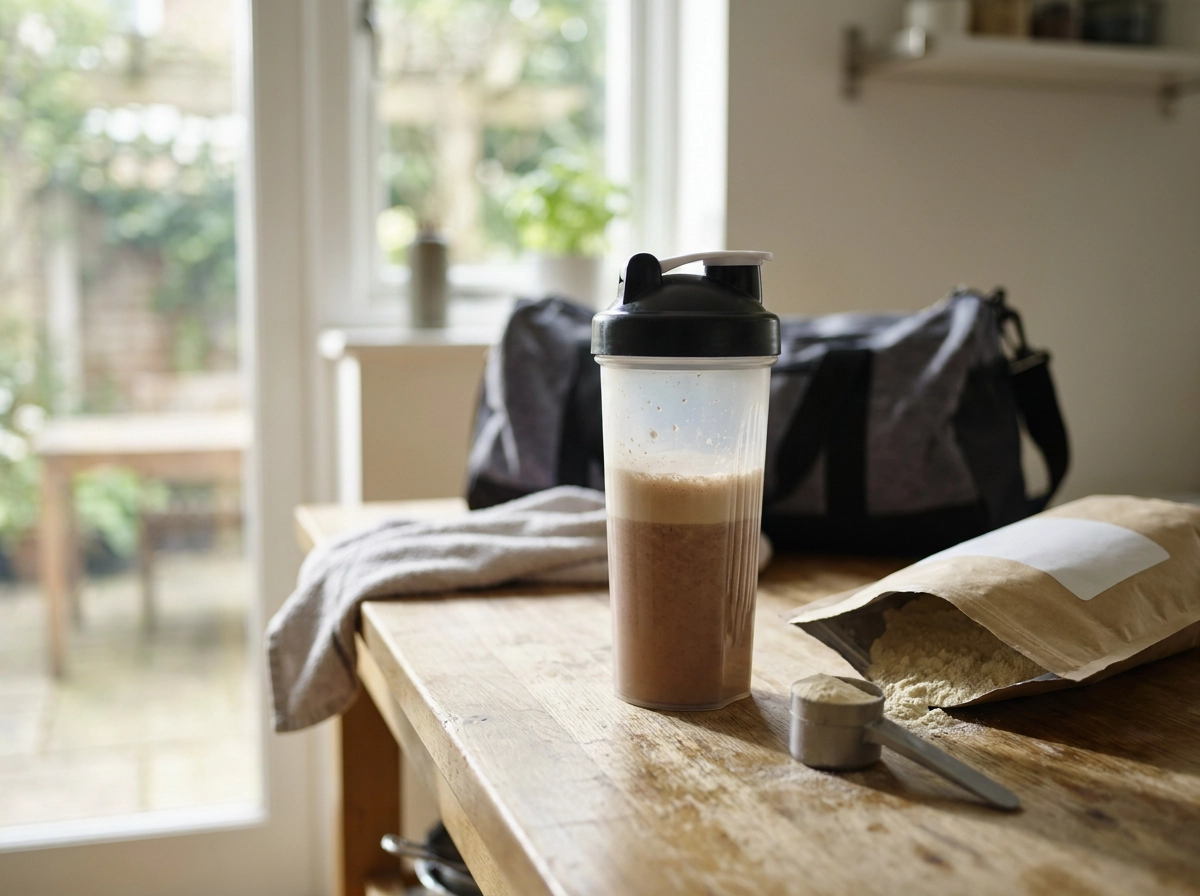
Step 3: Where Protein Powder for Muscle Recovery Actually Helps
So if a shake is only a delivery method, where does powder actually earn a place? On honest merits: protein powder is convenient and easy to consume when appetite is suppressed after a hard session or in the heat. That is a logistics win, not a recovery upgrade.
As the previous section established, a shake adds no recovery value beyond its amino acids and can reduce total intake when it displaces a solid meal. Powder also cannot rescue an underfed day, short sleep, or a training load that has outrun your capacity to recover.
If you like powder, use it as one feed among your daily total rather than the anchor of your day. Keep a simple note of the days it genuinely rescued your total. That is coaching judgement, not product selection, and it sits at the heart of what a personal trainer actually does.
Step 4: The Points Where a Coach Changes the Numbers
You now know where powder helps. The harder skill is knowing when the daily numbers move. Treat all of this as coaching judgement: no source in the material sets change thresholds, so these are the triggers I watch for in practice and test against logs.
- Training load: Physical activity raises the capacity to use ingested protein, so a meaningful shift in volume or intensity warrants reviewing the total.
- Body mass and composition: Fast weight loss, stalled strength, or unintended loss of body mass means reviewing the total and the calorie context together, not just adding protein.
- Appetite: Suppressed appetite during heavy weeks calls for more energy-dense or liquid options, not more volume of food pushed at someone who cannot eat it.
- Schedule: Travel, shift work and double session days break distribution long before they break totals. Rebuild the feeding pattern first, then revisit the number.
- Review rhythm: In practice, checking every two to three weeks against training logs and the body mass trend is a workable review rhythm. Daily tweaks are noise.
The same individual judgement applies to choosing support, so how to choose a female personal trainer in Australia: what credentials don’t show is worth reading.
What This Looks Like Across a Real Training Week
The triggers above only matter if they translate into a week you can actually run. Here is a generic four-day structure, with every number bracketed so you can scale it to your own body mass.
Across four training days, daily protein sits at roughly [X to Y g]. That is split across [four or five] feeds of about [X g] each. On two of those days, a shake does real work: one when a session finishes hours before the next meal, another when an early start makes cooking unrealistic.
On a rest or light day, the total stays broadly similar. Repair continues away from the gym, so keep the feeds and the spacing rather than dropping to two big meals.
On a heavy double session day, totals rise modestly to [X to Y g]. The split stays the same. What changes is timing: protein close to each session, not a larger shake once.
If you need a structured week to slot this around, my 6-Week Full-Body Program: 3 Days/Week gives you the sessions.
Screenshot summary:
- Daily total: [X to Y g], scaled to body mass
- Feeds: [four or five]
- Per feed: [X g]
- Powder earns its place when: a session ends far from a meal, appetite caps solid food, or cooking is unrealistic
Getting Numbers Built for You Instead of a Generic Range
That week is the template. The spine holds wherever your numbers land: set a daily total, split it across the day, use protein powder only where it solves a logistics or appetite problem, and let real food carry the rest.
Three actions for this week:
- Calculate your per kilo target and round it to something sustainable, not a decimal.
- Move 20 to 30 g of protein into breakfast.
- Count feeding occasions on two training days.
As Step 4 covered, training load, appetite, composition and clinical factors are the triggers for adjusting those numbers. That is where one-to-one coaching earns its keep. For a sense of what that standard looks like, read Personal Training in 2026: What the Industry Is Still Getting Wrong.
Then judge the change properly. In practice, running two to three weeks of consistent distribution before touching the numbers again is the right approach. Use body mass trend and session quality as your markers; nothing else moves fast enough to read.
Conclusion
Protein needs for an active adult come down to a few durable principles. The actions above, calculating a per-kilo target, adding protein to breakfast, counting feeds on training days, and giving any change two to three weeks, are the next steps.
Your next step is simple. Calculate your per kilo target, round it to something sustainable, and count feeding occasions on your next two training days. If your training load is high and variable, or appetite and body composition are shifting, one-to-one coaching in a private gym setting can build the numbers around your week. Start with breakfast tomorrow.