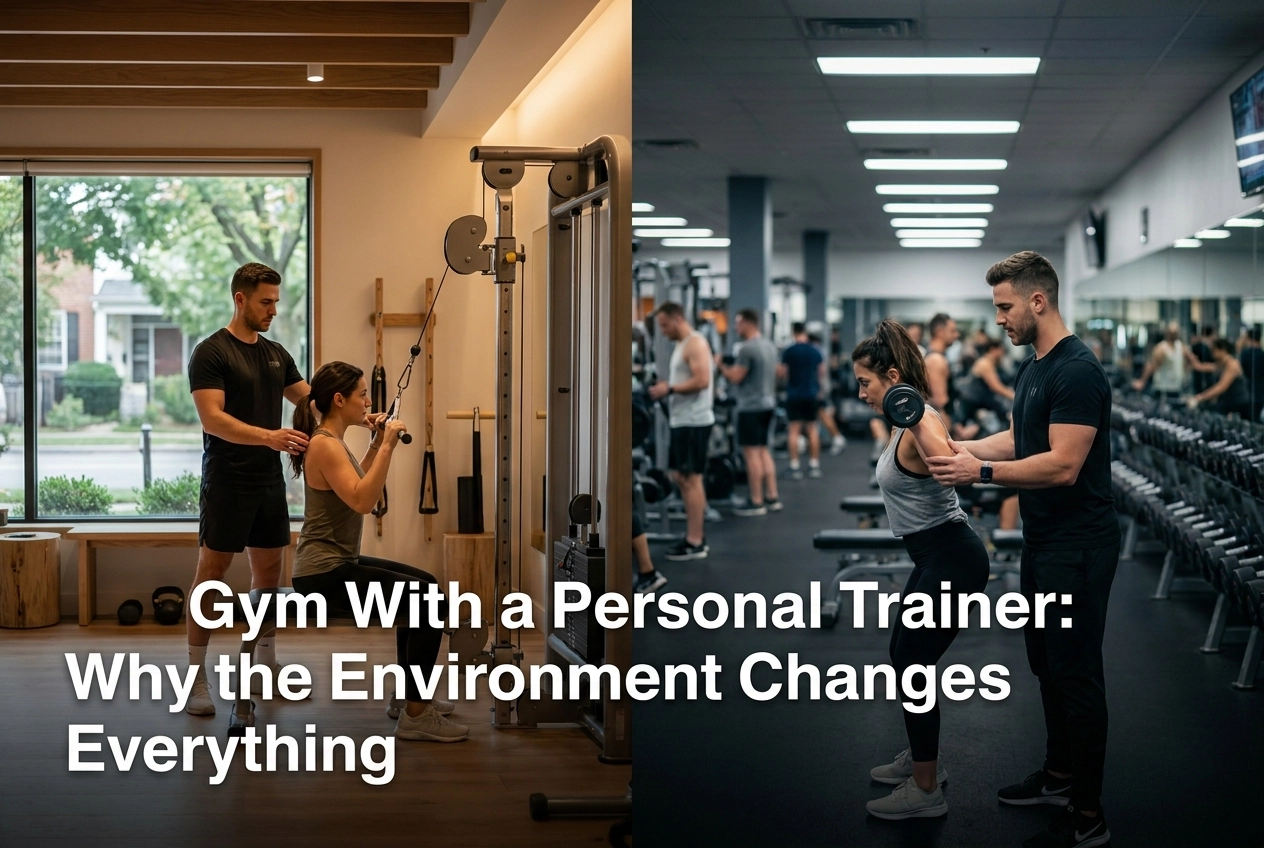
Most people assume that hiring a personal trainer is simply about having someone count your reps and push you harder. The reality is far more nuanced than that. Where you train matters just as much as how you train, and the environment surrounding your sessions can be the difference between plateauing for months and hitting genuine, measurable progress.
Whether you are weighing the benefits of a commercial gym with a personal trainer versus private studio training, in-home sessions, or boutique fitness facilities, the setting shapes everything from your mindset to your physical performance. The equipment available, the noise levels, the social dynamics, even the lighting, all of these factors influence how effectively you and your trainer can work together.
In this post, we are going to break down exactly how different training environments affect your results, your motivation, and your overall experience. If you are an intermediate lifter or fitness enthusiast serious about optimizing your training investment, understanding these distinctions is not optional; it is essential. By the end, you will have a clear framework for choosing the right environment to match your goals.
What Most People Mean When They Search for a Gym With a Personal Trainer
When most people search for a gym with a personal trainer, a familiar scene comes to mind: a certified trainer on a busy gym floor, sessions slotted into 45-minute blocks, shared equipment, and a room full of other members doing their own thing. It is the dominant delivery model the fitness industry has built its identity around, and for good reason. It is accessible, widely available, and staffed by genuinely qualified professionals in many cases.
What is less commonly understood is that the commercial gym PT model is volume-driven by design, not by any failure of the trainers working within it. The business economics of a large gym depend on throughput. Trainers are often incentivised to run back-to-back sessions, which structurally limits how much depth any single client relationship can reach, regardless of the trainer’s expertise or intentions. The constraint is architectural, not personal.
Within that structure, session-level programming is frequently solid. A good commercial trainer can coach sound technique, push appropriate progression, and keep clients motivated within the hour. What the model rarely supports is the kind of integration that drives sustained results: programming that accounts for sleep quality this week, connects to nutritional periodisation across a training block, and factors in cumulative recovery load over months. That depth requires a different environment and a different model entirely.
The scale of demand here is significant. The global personal fitness trainer market reached USD 45.6 billion in 2025 and is projected to grow to USD 80.5 billion by 2036, reflecting both rising demand and a market that is actively bifurcating between volume-based and premium specialist offerings. Critically, in-person training still holds 60% of the personal training service market in 2026. Clients want a human in the room. The sharper question is what that human delivers, and in what environment they are empowered to deliver it.
What a Private Gym Training Relationship Actually Delivers
The difference between a standard gym floor personal trainer and a fully private training relationship is not simply cosmetic. It is structural, and it compounds across every session, every week, every training block.
The Environment Changes What Is Possible
A private gym removes the variables that quietly erode session quality: no waiting for equipment, no ambient noise from crowded free weights areas, no self-consciousness about being observed mid-set. These may seem like minor conveniences, but their cumulative effect is significant. When a client does not feel watched, assessed, or rushed, honest conversation about fatigue, plateaus, and motivation becomes far easier. The psychological safety of a private environment directly enables the kind of candid coaching dialogue that drives real behaviour change, something the NASM CPT curriculum codifies as the trainer’s most transferable long-term skill.
Meticulous Planning as a Non-Negotiable Standard
Every session delivered within a high-quality private training relationship arrives with a documented purpose. The session is not chosen on arrival; it is a pre-planned stimulus derived from where the client sits within their current programme phase. Expected adaptations are identified in advance. Recovery considerations, including tissue load, sleep quality from recent check-ins, and stress markers, are factored into what is prescribed that day. This approach draws directly on periodisation principles and the stimulus-recovery-adaptation cycle. It treats each session as one data point within a longer arc, not an isolated event.
Multi-Service Integration Eliminates the Information Gap
When training, sports massage, recovery support, and nutrition guidance exist within a single unified relationship, nothing is lost in translation between providers. A trainer who also delivers soft tissue work after a demanding training block has real-time knowledge of how the body is responding. Nutritional adjustments are made with full awareness of training load, not in isolation. The 2026 NASM State of the Personal Trainer Report, surveying 1,133 trainers, makes this explicit: recovery, sleep management, stress coaching, and nutrition are now described as the new baseline for premium training relationships, not optional add-ons. Framing this as “fitness without wellness is like fire without fuel,” the report confirms that integrated service depth is where modern premium training is heading.
A Limited Roster Is a Quality Mechanism
Working with a deliberately limited number of clients is not a capacity constraint; it is a quality guarantee. When full cognitive and planning attention is directed at a smaller number of individuals, programme design is genuinely individualised rather than drawn from a rotating template. The NASM report reframes the modern premium trainer as an Essential Human Partner, delivering empathy, expert individualisation, and behaviour change outcomes that AI-assisted generic programming structurally cannot replicate. This human quality is inseparable from the attention available per client. A trainer managing high session volume simply cannot provide the same planning depth as one working within a deliberately smaller roster, regardless of credential level.
What this section outlines is not a premium framing exercise. It is a practical description of what changes when the environment, planning rigour, service integration, and trainer attention are all optimised simultaneously rather than traded off against each other.
Private Gym Personal Training vs. Commercial Gym PT: A Direct Comparison
The environment in which training takes place is not a background detail; it is a direct determinant of session quality. On a commercial gym floor, equipment availability, ambient noise, and the constant movement of other members create logistical friction that consumes both session time and mental bandwidth. Waiting for a rack, adapting a planned superset because a station is occupied, or coaching a technically demanding movement against a backdrop of noise all erode the productive window of the session itself. A private gym removes those variables structurally, not incidentally. Every minute of a private session is available for the stimulus, the coaching cue, and the recovery interval it was designed for.
Planning depth separates the two models just as clearly. Commercial PT sessions are frequently constructed in isolation, with the next session planned only after the previous one has concluded. A genuinely integrated private model operates on a fundamentally different timeline: programming is mapped weeks ahead, with explicit recovery phases, nutrition adjustments, and movement progressions built into the plan before the week begins. This is not a minor operational difference. It determines whether fatigue is managed proactively or reactively, and whether adaptations compound or stall.
Service scope represents perhaps the sharpest contrast between the two models. Standard commercial PT is scoped to exercise prescription within the session itself, leaving the majority of the adaptation cycle entirely unmanaged. A private model that integrates training, sports massage, recovery protocols, and nutrition support addresses the full picture: the training stimulus, the recovery from it, the nutritional environment that determines what that recovery produces, and the structural tissue work that keeps the body capable of tolerating progressive load. These are not optional additions; they are the components that determine whether training actually converts into durable physical change.
Client exclusivity has a direct structural basis. A commercial gym trainer maintaining a high client volume to meet income requirements cannot offer rapid programme adaptation, meaningful between-session support, or the kind of attentiveness that changes when life changes. A specialist working with a deliberately limited roster can. Research published in Heliyon (January 2024) confirmed that trainer-guided individualisation produces meaningfully distinct outcomes compared with generalised group-based approaches, reinforcing that responsiveness at the individual level is a performance variable, not a luxury.
Goal alignment is the final and arguably most consequential distinction. Commercial PT defaults toward aesthetic transformation cycles, typically framed around 8 or 12-week windows. Goals centred on longevity, healthspan, and sustainable performance require a longer planning horizon and considerably more service depth to deliver honestly. With 88% of trainers in the 2026 NASM survey identifying longevity and healthspan as their clients’ primary priority, the mismatch between what commercial PT is structurally designed to deliver and what intermediate-to-advanced clients actually need has become increasingly difficult to ignore.
The Longevity Shift: Why the Most Informed Clients Are Choosing Private
The fitness industry has reached a genuine inflection point. According to the 2026 NASM State of the Personal Trainer Report, surveying 1,133 active fitness professionals, 88% of personal trainers now cite longevity and healthspan as their clients’ number one priority, surpassing aesthetics for the first time as the dominant goal. This is not a marginal shift in preference; it represents a fundamental restructuring of why people train, what they expect from a coach, and which training environments are genuinely equipped to deliver on that expectation.
One of the most revealing data points in the same survey concerns who is driving this shift. 97% of Millennial trainers rank longevity above aesthetics as their clients’ primary goal. This dismantles a persistent assumption: that longevity-focused training is a concern reserved for older demographics managing decline. Clients in their 20s, 30s, and 40s are now training explicitly to preserve strength, mobility, and metabolic health decades into the future. The goal is not to look better next summer; it is to lift heavy and move freely at 70. That is a categorically different brief.
That difference matters because the programme structure required to honour it is fundamentally distinct from short-term body composition work. Longevity training demands periodisation across recovery quality, sleep, stress load, and nutrition, not progressive overload alone. The NASM report states this clearly: recovery, sleep management, stress regulation, and nutrition are now the baseline of competent coaching, not optional add-ons. As the report frames it, fitness without wellness is fire without fuel.
This is precisely where the structural contrast between private and commercial PT becomes decisive. A session-only, high-volume commercial environment has no mechanism to address recovery between sessions, no continuity of nutritional support, and no capacity to adjust programming against a client’s sleep data or accumulated stress load. A private training relationship with integrated sports massage, recovery support, and nutritional guidance is not simply a premium upgrade; it is the only model architecturally capable of meeting what longevity training actually requires. For informed clients who understand the goal they are working toward, that distinction drives the decision.
Sports Massage and Recovery: The Missing Layer in Most Training Programmes
The 2026 NASM State of the Personal Trainer Report is unambiguous on this point: recovery, sleep quality, and stress management are no longer optional enrichments to a training programme. They are baseline competencies. The industry framing is direct, positioning fitness pursued without integrated wellness as structurally incomplete, burning stimulus without the conditions required to produce adaptation. For clients who have moved beyond the beginner stage and are training with genuine intent, this reframing matters enormously. The question is no longer whether recovery support belongs inside a training relationship; it is whether the model you are using actually delivers it.
The structural gap in the standard commercial gym arrangement is worth examining honestly. Most intermediate clients accessing a personal trainer at a commercial gym and seeing a separate sports massage therapist believe they are covering their bases. In practice, they are operating with a critical information gap running in both directions. The massage therapist treats tissue without any knowledge of the current training load, session frequency, or where the client sits in a training block. The trainer programmes sessions without any feedback on tissue quality, areas of restriction, or how the body has responded to recent work. Each professional is making decisions with half the picture. That gap does not close through good intentions on either side; it closes only when both functions sit within a single, coordinated training relationship.
When sports massage is integrated into the same relationship that manages programming, the practitioner can read tissue readiness directly and adjust session intensity before loading decisions are made. A session that was planned as high-volume lower body work may be modified based on what soft tissue assessment reveals that day. This is not a minor refinement; it is the difference between training that accumulates productive stress and training that accumulates fatigue leading toward injury. Movement patterns between sessions, sleep quality, and psychological stress load all feed into the same equation, each one determining whether a given training stimulus produces adaptation or simply adds to the cumulative burden.
This level of integration is genuinely rare in the personal training industry. The NASM Corrective Exercise Specialization acknowledges the structural reality that movement quality data is routinely absent from standard training decisions, and that scope-of-practice boundaries actively prevent a trainer from holding the full clinical picture independently. A private specialist model, where training, sports massage, and recovery support are delivered within one relationship, resolves that boundary problem entirely. It is one of the clearest structural differentiators between genuinely integrated private training and anything a standard commercial gym environment is configured to provide.
How Wearable Data Is Raising the Bar for What Good Coaching Looks Like
Almost half of U.S. adults now own a fitness tracker or smartwatch, and the data these devices generate has quietly changed what clients bring to every session. Heart rate, sleep quality, recovery scores, heart rate variability, and increasingly glucose readings arrive before a single rep is performed. The question is no longer whether clients have biometric data. The question is whether their trainer is equipped to use it.
The 2026 fitness tracker market confirms that consumer devices now track an expanding range of clinically adjacent biomarkers, including ECG, blood oxygen, sleep staging, and AI-based recovery scoring. Wearable technology was ranked the number one fitness trend by the ACSM for 2026, marking sustained structural adoption rather than a passing cycle. This creates a direct professional expectation: trainers working at a premium level in 2026 are expected to interpret this data and act on it, not simply acknowledge it exists.
Heart rate variability is the most immediately actionable signal available. A peer-reviewed 2025 study published in Sensors (Basel) confirms HRV as a validated, non-invasive biomarker reflecting autonomic nervous system recovery, measurable via the consumer devices clients already own. A suppressed HRV reading paired with a poor sleep score provides an evidence-based reason to modify or replace a planned high-intensity session with recovery-focused movement work that day. This is responsive coaching grounded in published kinesiology research.
The operational reality matters here. Reviewing wearable data before each session, cross-referencing it against training history, and adjusting programming accordingly requires time and a manageable client roster. Within a private specialist model, that capacity exists by design. Within a back-to-back commercial gym schedule, it rarely does.
Clients who arrive wearing a device generating meaningful fitness and health data and hand that information to a trainer who ignores it are receiving less value than their own technology enables. The gap between data collected and data applied is a coaching gap, and a private training environment built around a limited client roster is specifically structured to close it.
What to Look for When Choosing a Gym With a Personal Trainer
Not all training relationships are built equally, and the environment, structure, and credentials behind a service determine whether results compound or stall. Use these six criteria as a practical filter before committing to any gym with a personal trainer.
Ask directly whether sessions take place on a shared gym floor or in a dedicated private space. The answer matters more than most people realise. A shared floor introduces variables that quietly erode session quality: equipment access, ambient noise, interrupted focus, and the practical impossibility of holding a meaningful conversation about recovery, stress, or nutrition mid-set. A dedicated private training environment removes those variables entirely and creates the conditions for the kind of depth that actually moves results forward.
Look for an integrated service offering. A trainer who delivers or actively coordinates sports massage, recovery support, and nutrition guidance within a single relationship removes the coordination gap that consistently undermines progress when these elements are managed separately. When exercise, recovery, and nutrition are siloed across different providers, the connections between them go unmanaged. A coach who holds all three removes that structural weakness.
Test for session planning transparency. A premium trainer should be able to explain the purpose of this week’s sessions within the context of next month’s adaptation targets, not just instruct you through a workout. The ability to connect today’s effort to a longer-term physiological outcome is the mark of genuine programme architecture rather than ad hoc instruction.
Assess credential depth beyond the standard personal training certification. Qualifications in movement, nutrition, recovery, and wellness signal that the trainer can coach the full adaptation cycle. Standard certification covers the basics; additional specialisations indicate the trainer is equipped to manage the whole picture.
A deliberately limited client roster is a meaningful proxy for quality. A trainer who restricts the number of clients they work with is prioritising depth of delivery over booking volume. That choice has direct implications for the attention, planning, and responsiveness each client receives.
Finally, ask how the trainer uses your data. With almost half of U.S. adults now owning a fitness tracker or smartwatch, wearable and biometric data is arriving in the coaching relationship whether trainers are prepared for it or not. A specific, thoughtful answer to how subjective recovery feedback or sleep trends inform session planning is a strong signal of a genuinely responsive coaching process, not a reactive one.
The Environment Is Part of the Programme
Where and with whom you train is a strategic decision, not a procedural one. The gym environment, service model, and level of integration determine outcomes as much as any individual session. A private gym with a genuinely integrated personal trainer delivers what commercial gym PT structurally cannot: uninterrupted focus, meticulous session planning, multi-service support across training, sports massage, recovery, and nutrition, and the depth of relationship that only comes from a deliberately limited client roster. When your coach carries a capped number of clients, the quality of attention you receive compounds over months and years in ways a high-volume commercial model cannot replicate.
With 88% of trainers identifying longevity and healthspan as clients’ top priority in 2026, the model you choose now carries consequences well beyond your next training block. Physical capacity in your 50s, 60s, and 70s is shaped by decisions made today. Every year spent in a structurally inadequate training environment is a year of compounding missed adaptation.
If you are ready to move beyond session-by-session training and into a genuinely integrated private coaching relationship, the most practical first step is a direct conversation about fit. TheMcLeod Method works with a limited number of individuals at any one time. An initial consultation is the natural starting point: it establishes whether the approach suits your goals, and whether a place is currently available.
Conclusion
The environment where you train is not a minor detail; it is a foundational variable that shapes your results, your mindset, and the quality of your relationship with your trainer. A commercial gym offers variety and energy, while a private studio provides focus and personalization. Your noise tolerance, equipment needs, and training goals should all factor into this decision. And the right fit can genuinely accelerate your progress in ways that no program adjustment alone can achieve.
Now it is time to act on what you have learned. Evaluate your current training environment honestly. Does it support your goals, or is it quietly working against them? Schedule a consultation with a personal trainer who operates in a setting that aligns with your needs. The best program in the world still needs the right environment to thrive. Choose your space wisely, and your results will follow.