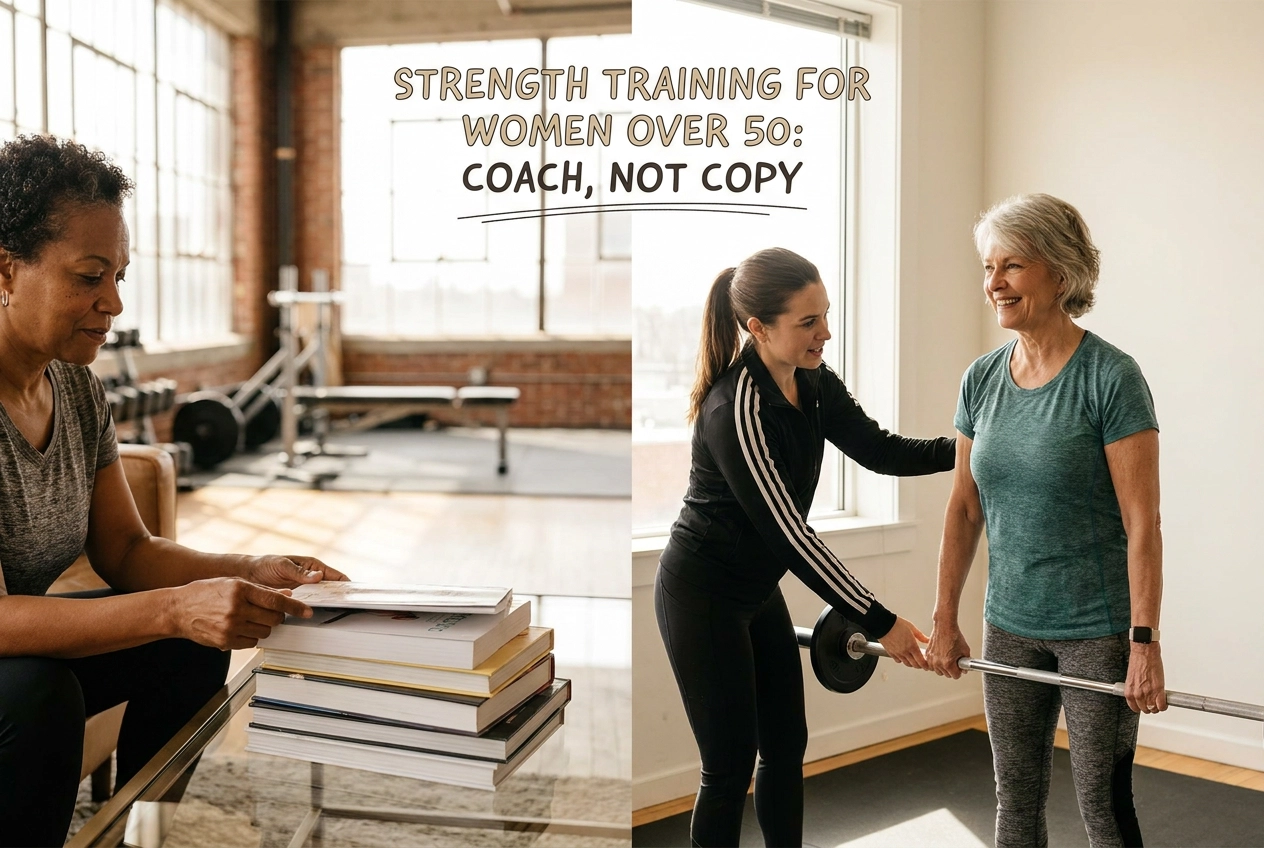
The appeal of a ready-made plan is obvious. A quick search promises a simple template for strength training for women over 50, and it feels like a solid first step. But your body has a history that no generic program can account for. The variables that matter most in the beginning are entirely individual: your injury history, your current load tolerance, and your confidence under a bar. Strength training is proven to work, but the path to results is not one-size-fits-all. This analysis will show you why the first eight weeks are a critical period for building a foundation safely and effectively. We will explore why that copied plan was written for someone else, why the eight-week mark is so significant, and the three variables that are yours alone. You will learn what coached progression actually involves and how to choose a coach who can guide you through your first eight weeks.
The Plan You Copied Was Written for Someone Else
You have an eight-week plan on your phone, a friend’s routine forwarded by message, or nothing yet, the sense you should be doing something. The worry is not laziness but fear of getting it wrong alone.
A 2025 review on resistance training for women lists perceived time and effort, intimidation and psychological factors among the main barriers to participation (Sports Medicine and Health Science).
A template cannot know the shoulder that clicks overhead, the knee you stopped trusting, whether you have ever held a barbell, or how much load your body accepts on a given Tuesday.
Plainly: strength training after 50 works. The first eight weeks work best coached rather than copied, because the variables deciding early progress are individual to you.
What follows: the evidence, global research below first, the three variables that belong to you alone, what the first eight weeks look like, what to ask a coach, and how to judge progress at the eight-week mark. If weighing coaches, this guide to choosing a personal trainer in Sydney sets out what the standard should look like.
Does Strength Training Still Work After 50?
Yes. A 2026 narrative review of peri- and postmenopausal women found strength improvements described as moderate to large. Separately, a 2022 meta-analysis across 12 trials and 452 postmenopausal women reported no serious adverse events. Together, the evidence frames training as a way to push back against menopause-related declines in strength and physical function, rather than accepting them as inevitable.
The prescription itself is not new. The NSCA position statement for older adults recommends 2 to 3 sets of 1 to 2 multijoint exercises per major muscle group at 70 to 85% of 1RM, 2 to 3 times per week.
Your 1RM is the heaviest weight you could lift once with good form. That range is where working sets eventually land, not a weight to pick on day one. Beginners start well below it and build.
Recognition is not the same as a plan built around your body and your history, which is why what to look for in a personal trainer matters.
Why Eight Weeks Comes Up Again and Again
So the training works. Why does eight weeks keep appearing? A 2026 narrative review reports favourable strength adaptations most often when programmes were progressive and sustained for at least eight weeks. What that finding does not say matters: it is a qualitative review of peri- and postmenopausal women broadly, not a study of women over 50 specifically, and it does not compare coached with unsupervised starts. Being straight strengthens the case.
Eight weeks is still a useful review point. It is long enough for technique to settle and load to climb, and short enough to judge real progress and change course if something is not working.
Progressive in plain English means adding load, reps or movement quality over time rather than repeating the same session indefinitely. That needs someone making a decision each week, not a printed sheet. If a programme is neither individualised nor progressed, eight weeks can pass without the adaptations the research describes. That is the argument for coaching, and for understanding what a personal trainer actually does when the plan is built around you.
The Three Variables That Are Yours Alone
Three variables no template can capture decide your start.
Load tolerance is how much weight your body accepts today. It shifts with training history, current strength, sleep, stress and recency of training, so two women the same age should rarely start identically.
Joint history shapes exercise selection before load. Past injuries, surgery, arthritis or a long-standing niggle determine which movements you begin with, load later, or work around rather than push through.
Confidence under a bar is a training variable, not a personality trait. A press looks simple in a video; overhead, it feels different. A 2025 review lists intimidation and psychological factors as genuine barriers to women starting and staying. Scaled options, including this bodyweight chest and shoulder progression, build control before weight.
A coach uses all three together: screening movement and history before loading, choosing the first weight deliberately, and rewriting the week when any variable shifts. Self-assessment also has limits. Judging your own technique and load tolerance from the inside is hard; a set that felt fine can look quite different from three steps back.
What Coached Actually Means in Practice
Identifying those three variables is one thing. Translating them into a plan is another, and it is the coach’s job. The NSCA position statement asks for appropriate instruction in technique and proper spotting, both are named in the NSCA guidance, and both are difficult to replicate without a person in the room. It also recommends an individualised, periodised approach, where training is built around you and structured over time. In practice, that means today’s load depends on how the last set moved, how you slept, and whether the shoulder you mentioned last week is still talking. Before any of that, your first session should establish movement quality and current tolerance, with medical clearance where something needs checking. Sets, reps and progressions are written down and reviewed together, so eight weeks become a record of decisions rather than a repeat of week one. This is also the standard to apply when evaluating a coach, as covered in our guide to choosing a female personal trainer.
What the First Eight Weeks Tend to Look Like
With those coaching decisions in place, the first eight weeks usually follow a recognisable shape. In weeks 1 to 2, expect fewer exercises, careful loads and time spent learning positions, bracing and breathing. The practical goal is finishing a session able to repeat it in two days without paying for it. In weeks 3 to 5, once form holds under light weight, weight or reps climb, progressing toward the NSCA range of 70 to 85% of 1RM on working sets for major muscle groups. In weeks 6 to 8, sessions become consistent, technique holds under meaningful load, and you and your coach decide what the next block should address rather than drifting. Treat this as typical, not guaranteed: the 2026 review found adaptations most often with progressive programmes sustained at least eight weeks, but joint history, recovery, sleep and attendance vary the timeline. Across all eight weeks, keep 2 to 3 sessions weekly, 2 to 3 sets of 1 to 2 multijoint exercises per major muscle group, and progression you can see in a training log. A shorter full-body structure, such as this 6-week full-body program, can help you picture session flow, but your load still needs individual decisions.
How to Choose a Coach and What to Ask First
Before you commit to eight weeks, interview the coach. Ask how the first sessions are used. A coach worth hiring screens movement and history before adding load, rather than starting you on a standard session and adjusting later. Ask how load is decided. The answer should mention technique, how the previous set moved and how you are recovering that week, not a fixed starting weight from a chart. Ask about technique instruction and spotting. Both are named in the NSCA guidance for older adults, so both should appear without prompting. Ask who writes the plan and who changes it. That is how sessions at McLeod Method are planned and delivered, one client at a time in a private gym setting. That setting matters: a limited client list makes session-by-session adjustment practical, and it removes the gym-floor intimidation research keeps flagging. If you are weighing broader support, read What Wellness Coaching Is (And What It Is Not): A Buyer’s Guide for Australians.
What Weight Should a Woman Over 50 Start With?
There is no single correct starting weight. It depends on your training history, your technique on the day and how the first sets move. That is exactly why a template cannot answer this question for you.
A reliable approach is to start lighter than you think you need, complete the target reps with clean form and leave a couple of reps in reserve rather than training to failure. As our pro tips and progressions explain, patience here pays off.
The NSCA range of 70 to 85% of 1RM applies to working sets for older adults, but it is reached across weeks of progression. It is not a day-one target. The signal to add load is consistent technique across all sets and reps, not a feeling that you should be doing more.
How often you train shapes this further.
How Often Should You Train?
Once the starting weight is settled, the next decision is how often to train. Established guidance for older adults points to 2 to 3 resistance sessions per week, with 2 to 3 sets of 1 to 2 multijoint exercises per major muscle group. In practice, two well-executed sessions tend to achieve more than four rushed ones in the early weeks: technique is the priority, and accumulated fatigue interferes with learning it. A useful rule of thumb: lingering soreness, disturbed sleep or a clear drop in performance are reasons to adjust the next session rather than push through it. Map frequency around your actual week, your joint history and any other training you do. That is a conversation, not a fixed schedule.
What if You Have an Old Injury or a Sore Joint?
Joint history belongs in that conversation about your week. It shapes exercise selection first and loading second, which is why one routine rarely suits two women with different histories.
The approach is to work around, not through. A good coach substitutes a movement that trains the same pattern without aggravating the joint, then returns to the original when it is ready.
Anything unresolved or undiagnosed needs medical clearance first. Expect a coach to ask about it before the first loaded session, not after.
Then keep notes: which movement, at which load, triggered which symptom. That detail turns a vague ongoing issue into a specific adjustment.
A sore knee is not a reason to avoid strength training. It is a reason to be precise about it.
Is It Too Late to Start at 60 or 70?
An old injury is something you work around, not a reason to wait. In fact, the evidence points the other way. The same evidence base that applies earlier in life holds here, and the starting point, not the direction, is what changes.
What changes with age is the starting point, not the direction: lighter initial loads, more technique work, longer progression and more attention to recovery. The usual constraint is confidence and guidance rather than capability, which is precisely where a coach earns their place.
Your First Eight Weeks Are Worth Doing Properly
Whatever your age, the principle holds: strength training works, and the first eight weeks are where technique, load tolerance and confidence under a bar are set, for better or worse.
Practical steps before you start:
- Get unresolved pain or old injuries checked before adding load.
- Train two to three times a week.
- Start lighter than you think you need.
- Log every set so progress is visible.
Before you begin with any coach, ask three questions: how the first sessions are used, how load is decided, and how they teach technique and spot you. The answers tell you whether you are getting a plan built for you or a template with your name on it.
At eight weeks, review the real numbers and set the next block from what actually happened.
Conclusion

Strength training after 50 is not a question of whether it works. The evidence is clear that it does. What changes is the starting point, and that is why the plan you follow matters more than the plan you copy.
The first eight weeks set technique, load tolerance and confidence, and the steps and questions earlier in this post are how to approach them. The direction is forward. Start.