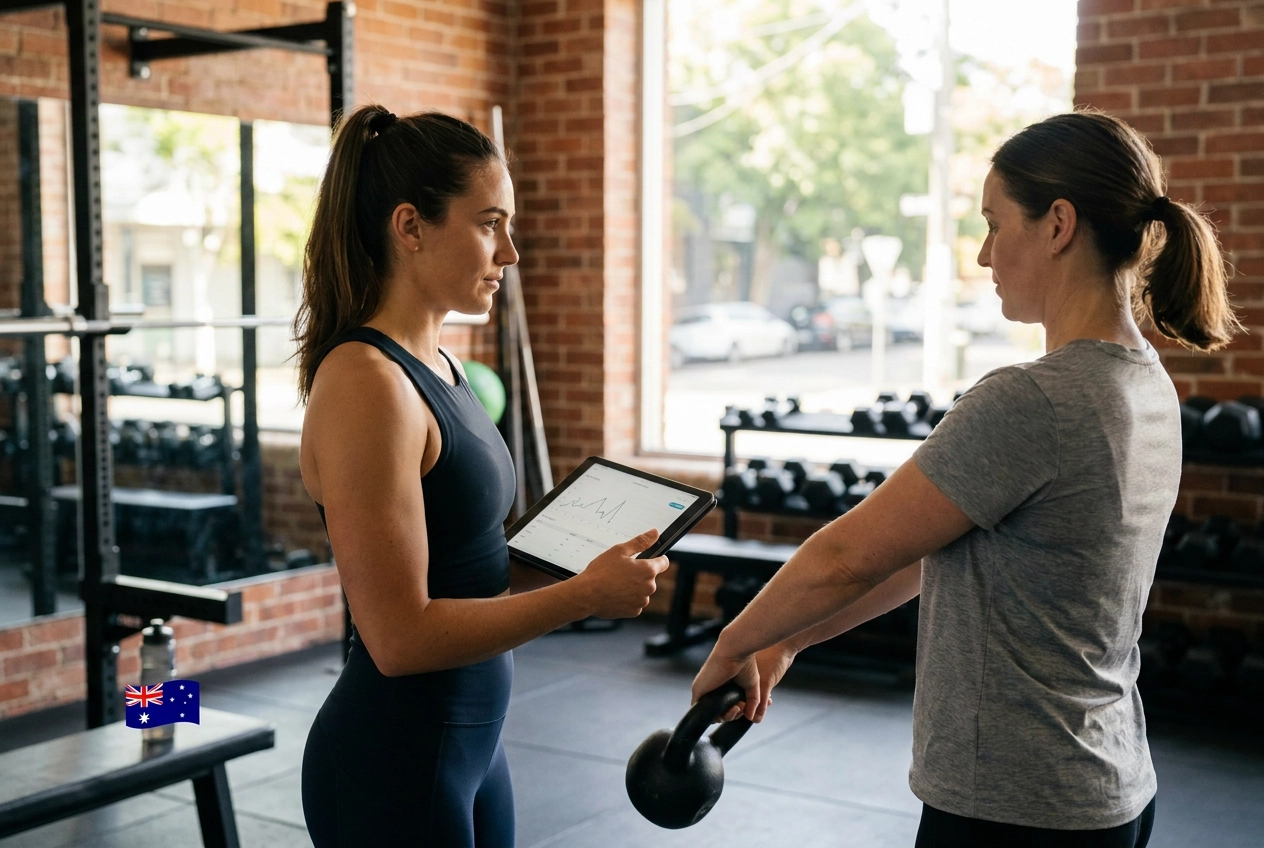
Searching for a female personal trainer near me sounds straightforward until you realise that the trainer with the most certificates on her wall is not automatically the one who will get you results. In Australia, a Certificate IV in Fitness or above, the nationally recognised training qualification, is now the entry point to the profession, not proof of coaching excellence. Every competent trainer has them. That means the real evaluation starts where most people stop looking.
What actually separates an average training experience from one that drives consistent progress comes down to factors that credentials simply cannot capture: how a trainer structures her sessions, whether her programming accounts for female physiology, how she communicates under pressure, and whether she creates an environment where you feel safe enough to push hard.
This guide is built for intermediate-level clients who already understand the basics and want to make a genuinely informed hiring decision. You will learn how to assess programming philosophy, identify the consultation questions that reveal a trainer’s adaptability, recognise red flags before you sign anything, and understand why the training environment itself shapes your outcomes. Credentials are the floor. Everything covered here is the filter.
Why Credentials Are the Floor, Not the Filter
Before you evaluate anything else about a personal trainer, check one box: accreditation. In Australia, three bodies cover this ground. AUSactive (formerly Fitness Australia) registers fitness professionals, sets continuing education requirements, and enforces a code of conduct for personal trainers and group exercise instructors. Exercise and Sports Science Australia (ESSA) accredits exercise scientists and exercise physiologists to a higher clinical standard, with professional standards that define competency across assessment, program design, and client management. A third body, the Australian Institute of Fitness, also operates in this space. Any working personal trainer should hold current registration with at least one of these bodies. If they cannot confirm it, the conversation ends there.
The problem is what happens next. These frameworks establish a baseline: anatomy knowledge, program design fundamentals, and safe practice. They do not, and cannot, measure what a trainer actually does with an individual client once the session begins. There is no accreditation test for responsiveness to fatigue signals, for adjusting load mid-set when something looks wrong, for communicating clearly under pressure, or for understanding female-specific physiology beyond standard anatomy. The distinction between private and commercial training environments matters here too, but that comes later.
Confirm them. Then move on to the questions below.
Does Her Programming Reflect Female Physiology, or Just Generic Principles
Once you have confirmed accreditation, the more revealing question is whether her programming is actually built for a female body, or simply scaled down from a generic template.
Female physiology introduces variables that standard certification frameworks do not adequately address. Menstrual cycle phase can affect strength output, recovery rate, and injury risk. Injury risk profiles shift across the cycle, and a trainer who is not tracking cycle phase cannot account for them.
Postpartum training carries additional complexity. Postpartum training carries specific load considerations that standard certification frameworks address only at surface level. A trainer who jumps straight to core work without assessing these factors is guessing, not programming.
Women with a history of hormonal disruption or underfuelling may have specific loading considerations that should surface at intake. If your initial consultation did not include questions about hormonal health history, you are likely looking at a template approach.
Ask directly: does she adjust training load, intensity, or exercise selection across the menstrual cycle, and how does she track it? A specific answer, naming tools, cycle phases, or load adjustments, signals genuine competency. A vague answer signals she has not thought about it.
This is not about training women more gently. Female gym trainers who genuinely understand women’s physiology will often push harder at the right moments, precisely because they know when the body is physiologically primed to respond.
The Consultation Question That Reveals Everything About a Trainer’s Adaptability
Knowing whether a trainer adjusts programming for your physiology is valuable. Knowing whether she adjusts it for you on the day is a separate skill entirely, and the harder one to evaluate before you have trained with someone even once.
The distinction matters: a trainer who arrives with a fixed plan and delivers it regardless of how you present is supervising, not coaching. That difference compounds over months. Missed fatigue signals become overreaching. Overreaching becomes injury. Injury becomes the gap in your training history that resets progress.
Ask this in your consultation: “If I arrived for a session and told you I’d had four hours of sleep and was feeling flat, what would you change?”
Listen for specifics. A strong answer names concrete adjustments: reduced volume, lower intensity thresholds, a shift toward technical skill work or controlled tempo. A weak answer offers reassurance (“we’d just see how you feel”) without any structural change to the session. Reassurance is not a programming decision.
Follow with a second question: “How do you handle a session where I hit a personal best versus one where I’m clearly not at capacity?”
This reveals whether she tracks individual baselines and responds to them, or runs the same linear progression regardless of what you bring that day. Both directions matter; elite programming responds to performance in both.
Beyond what she says, look at how she operates. Trainers who keep detailed session notes, use tracking tools, and refer back to previous sessions during the consultation itself are demonstrating meticulous planning behaviourally, not just claiming it. That is the signal worth trusting.
Communication Style and Why Psychological Safety Determines Whether You Train Hard
Adaptability tells you what a trainer will do. Communication style tells you whether you will actually let her coach you.
Psychological safety in a training context means you feel confident enough to report fatigue honestly, attempt unfamiliar movements without fear of judgment, and ask questions without feeling dismissed. Without it, you self-edit. You say you feel fine when you do not. You skip the heavy set rather than admit you are nervous about it. That self-editing quietly erodes the quality of every session.
Many women searching for a female personal trainer are trying to solve exactly this. They want an environment that is less performative and more focused on what they are actually there for, whether that is strength, body composition, performance, or injury recovery. The gender of the trainer matters less than what the coaching environment makes possible.
What to assess in a first consultation:
- Does she ask more questions than she answers?
- Does she listen without redirecting the conversation toward her own training philosophy?
- Does she reflect back what you have told her accurately, rather than summarising it into her preferred framework?
The specific flags to watch for in a consultation are laid out in the section below.
The environment reinforces or undermines all of this. A private gym removes the social surveillance of a commercial floor, which meaningfully reduces inhibition for many clients and allows harder, more honest effort. The difference is worth considering when exploring options beyond a generic “female gyms near me” search.
Finally, consultation tone and session coaching tone are not the same skill. Look for a trainer who can shift between technically instructive and encouragingly direct depending on what the moment requires, because those two modes serve very different purposes.
What a Well-Structured Session Actually Looks Like (and How to Spot the Difference)
Once the communication dynamic feels right, look at the session itself. Structure is where intent becomes visible.
A well-designed session has an internal logic you can follow without explanation. The warm-up addresses your movement limitations, not a generic five-minute bike ride. The main block runs heavier compound work first, before accessory exercises, because that sequencing preserves neurological output when it matters most. The close includes mobility or recovery work directly relevant to what was just trained, not a default stretch routine applied to every client equally.
Before committing to any trainer, ask to see a sample session plan. Look for rep schemes, load progressions, and written technique cues. A plan that lists exercises and sets without those details is a template, not a programme. Templates produce short-term fatigue; they do not build progressive capacity.
The session should also carry your history. If you reported knee discomfort a fortnight ago, today’s plan should show evidence the trainer thought about that across the whole session, including how load transfers to adjacent structures, not just that she swapped one exercise. Reactive substitution is not programming.
Ask two direct questions: how far in advance are sessions planned, and will you receive a record of what was done each session? Trainers who keep detailed logs are structurally more accountable and better positioned to make intelligent adjustments as your training evolves.
Environment is addressed specifically in the next section.
That is the practical distinction between a supervised workout and a coached session: every decision has a reason tied specifically to you.
Private Gym vs. Commercial Gym: Why the Environment Affects Your Results
Where you train is not a logistical detail. It is a variable that either supports or constrains everything your trainer is trying to do for you.
Commercial gym floors introduce conditions outside any trainer’s control: equipment occupied when it’s needed, ambient noise that disrupts cueing and concentration, other gym-goers observing your session, and in some cases a trainer splitting attention across multiple clients training simultaneously in the same space. Each of these is a friction point that competes directly with programming precision.
A private gym environment removes that friction structurally. Equipment is configured before you arrive. Sessions run without interruption. Your trainer’s attention is not divided. The space can be arranged to suit your specific program rather than whatever happens to be free. That level of consistency is not achievable on a shared gym floor, regardless of how skilled the trainer is.
For clients with specific goals, this distinction is material. Body composition work, injury rehabilitation, and performance training all benefit from controlled conditions because the trainer can manipulate variables deliberately rather than reactively. Consistency in environment produces more reliable data about what is and isn’t working in your programming.
The question worth asking any trainer you are evaluating: “Where exactly will we train, and what does that environment allow you to do for my programming that a standard gym floor would not?”
A trainer who has genuinely thought about environment as a coaching tool will give you a specific answer. A vague response suggests the environment has not been factored into how she delivers sessions at all.
This is not about atmosphere or exclusivity. It is about whether the setting you train in works for your results or against them.
Red Flags and Green Flags to Watch for in a First Consultation
The environment you train in sets conditions. What happens inside the consultation tells you whether the trainer can actually use them.
Green flags to look for:
- She asks for a detailed health history before offering any programming suggestions: hormonal health, injury history, sleep quality, and nutrition patterns. If she is sketching a programme before she knows these things, she is working from a template.
- She names what she does not specialise in and refers out accordingly. A trainer who acknowledges the edges of her scope has sharper professional judgement than one who claims to cover everything.
- She asks what your previous training experiences have been like, including what did not work. That question signals she is building a picture of you specifically, not slotting you into a system she has already decided on.
Red flags to watch for:
- The consultation feels like a sales pitch. Credentials, transformation photos, and client counts are not irrelevant, but if they dominate the conversation before she has asked about your situation, her priority is closing, not assessing.
- She cannot explain her programming rationale in plain language, or gives inconsistent answers when you ask the same question two different ways. Genuine competency survives rephrasing.
The same logic from the consultation questions above applies: specificity of response is the signal.
Your Evaluation Framework, Summarised
Once the consultation is behind you, the decision comes down to a clear sequence of priorities.
Verify accreditation first. Confirm your trainer is registered with AUSactive, ESSA, or an equivalent Australian body. Check the AUSactive directory directly; do not take a certificate photo as proof. That step is non-negotiable, and once it is done, set credentials aside entirely.

Then interrogate her programming knowledge. Her answers on cycle-phase programming (covered above) are your clearest signal here. Vague answers signal a template approach, regardless of how impressive the qualifications look on paper.
Assess her adaptability under realistic conditions. The scenario questions from the adaptability section apply directly.
Evaluate the training environment as a quality variable. The environment question posed earlier belongs on this checklist too.
If you are looking for a trainer who has worked through every layer of this framework, the approach behind the McLeod Method is built on exactly this model: one-on-one sessions in a private gym, meticulous session planning, real-time adjustment, and integrated recovery and nutrition support. It is worth a conversation.
Conclusion
Choosing the right female personal trainer means looking past credentials to the qualities they cannot capture.
Prioritise programming knowledge that reflects your hormonal health, not generic principles borrowed from male-dominated sports science. Ask specific, scenario-based questions during your consultation. Pay attention to the training environment, because where you train shapes what is actually possible.
You deserve a trainer who has thought deeply about every one of these variables before you walk through the door. Use this framework, ask the hard questions, and trust what the answers reveal. The right fit exists, and finding her will change what you believe you are capable of.